
2022-23 Folklife Apprenticeship Feature: Old-Time Fiddling with Gerry Milnes & Annick Odom
Written by Mary Linscheid
This article features one of seven pairs supported by the statewide West Virginia Folklife Apprenticeship program in 2022-2023.
NOW through August 26, 2024, apply for the 2024-2025 program!

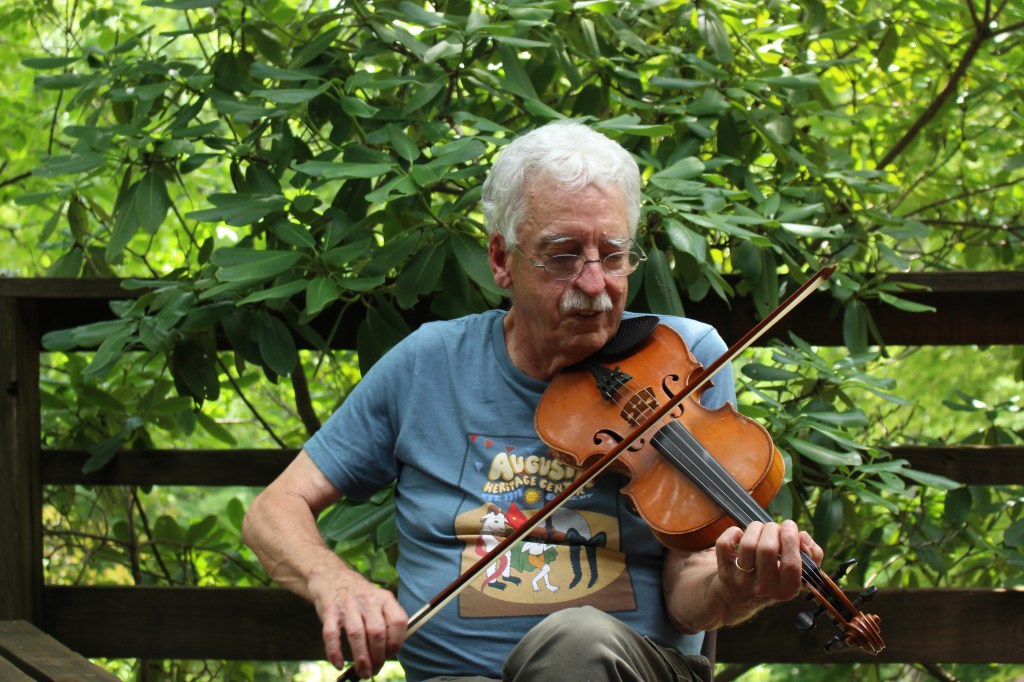
During the 2022-2023 West Virginia Folklife Apprenticeship Program, Gerry Milnes (Randolph County) and his apprentice, Annick Odom (Monongalia County), dove deep into West Virginia old-time fiddling tunes, techniques, and stories. Gerry—born in 1946 in Germantown, Pennsylvania—was introduced to bluegrass at an early age. Inspired by his older brother who played in a country band, Gerry took up the guitar at age nine and the banjo at age twelve. As a young man, he traveled around to various bluegrass and folk festivals where he eventually discovered his love of traditional old-time fiddling.
“There was an old guy in the parking lot playing old-time fiddle tunes and I spent the whole weekend with him. I didn’t even listen to the stage show. I said, ‘that’s what I like,’ so I got a fiddle.” — Gerry Milnes
Gerry moved to West Virginia in 1975 where he documented and made friends with many traditional musicians, artists, and storytellers. A few years later, he began teaching fiddle workshops with the Augusta Heritage Center in Randolph County where he was eventually hired as their Folk Arts Coordinator—a position he held for 25 years. Throughout his long career, he has published several articles and books, collected countless oral histories, photographs, and videos, and produced many records and documentaries exploring topics and people in West Virginia folklife. He also coordinated the Augusta Apprenticeship Program, which 2022-2023 WV Folklife Apprenticeship Program members Chris Haddox, Joe Herrmann, and Dakota Karper participated in previously. Gerry continues to teach workshops at the Augusta Heritage Center even after his retirement in 2013. In 2016, Annick attended one of these workshops in which Gerry was teaching WV folk songs and ballads. They bonded over their shared admiration of WV ballad singer Phyllis Marks, striking up a friendship that became the foundation of their apprenticeship.
“I could tell from the first Augusta class I had with Annick that she was interested in a lot of the stuff that has always interested me and she’s come at it from a really interesting angle.” — Gerry Milnes
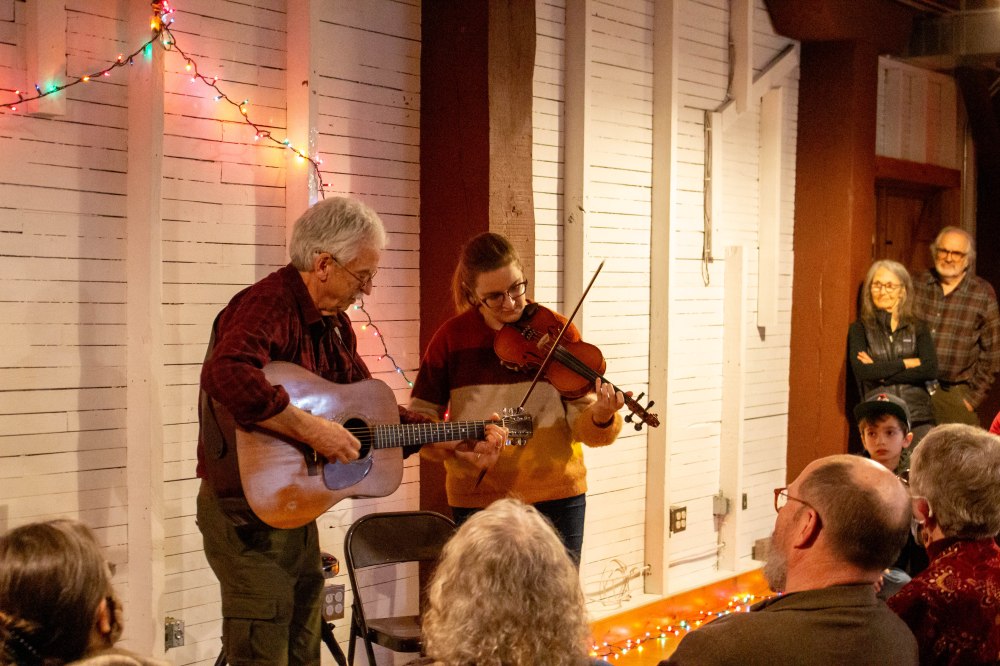
Annick Odom, a Belgian-American born in Morgantown, West Virginia, in 1992, was encouraged by her mother to study music from an early age. She participated in school orchestra and choir while taking lessons in violin, clarinet, and double bass. Annick went on to receive three bachelor’s degrees in Clarinet Performance, Double Bass Performance, and Psychology, and a Master’s of Music from the Royal Conservatoire of The Hague. Though she works primarily as a classical performer and composer, she is an avid student of many other musical genres and traditions, including West Virginia balladry and old-time fiddling.

During their apprenticeship, Gerry and Annick decided to focus on old-time fiddle tunes that commemorated places and events in West Virginia. Unlike a lot of fiddle tunes from the British Isles, West Virginia tunes—such as “Shelvin’ Rock”—are inherently tied to place. Gerry was able to take Annick to where this Carpenter family tune originated—just an overhanging rock where the first white baby was born in what is now West Virginia. Other examples include West Virginia river tunes, such as “Three Forks of Reedy” and “Boatin’ Up Sandy,” or tunes like “Camp Chase” which comes with the story of Devil Sol Carpenter winning a fiddle contest and, in turn, his freedom from a Union prison camp during the Civil War. (Gerry’s book, Play of a Fiddle: Traditional Music, Dance, and Folklore in West Virginia, explores this idea in West Virginia musical traditions.) Behind-the-scenes stories and experiences like these are what drew Annick to learning tunes through an apprenticeship versus through recordings.
“…What I was really interested in about Gerry was that he doesn’t only know about one fiddler he knows all—I don’t think I’ve been somewhere with Gerry that he hasn’t had someone tap him on the shoulder and say, ‘oh, hi Gerry, do you remember me?’” —Annick Odom

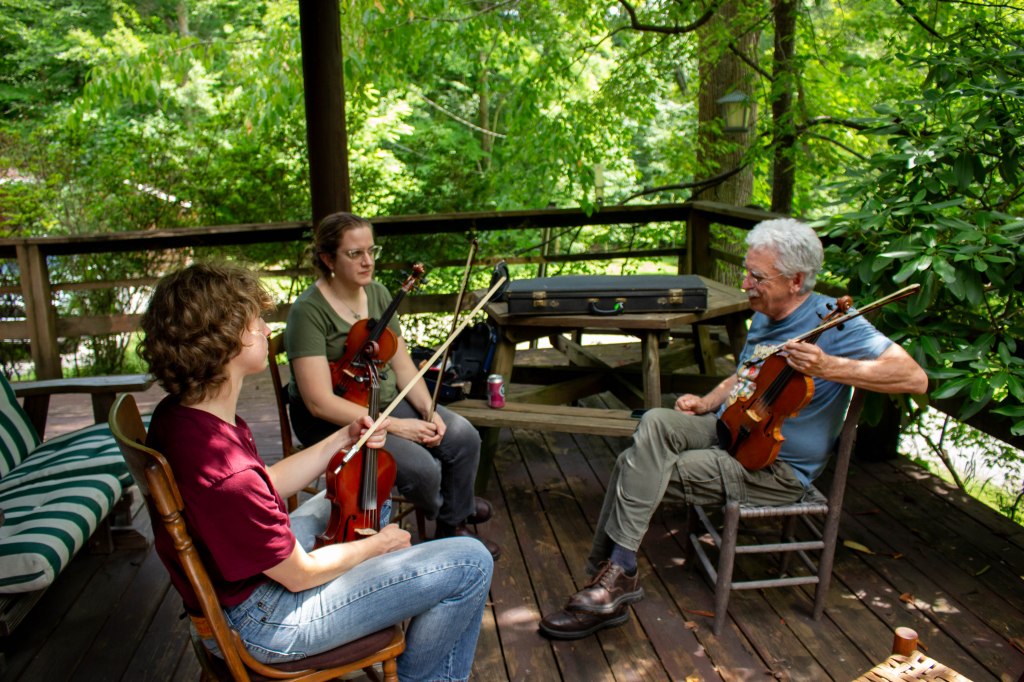
For most apprenticeship sessions, Annick drove to Gerry’s house in Elkins, West Virginia. They sat in the living room, knee-to-knee, fiddles in hand and no sheet music anywhere to be seen. Gerry would start by playing the tune through while Annick observed or attempted to play along quietly. Then, Gerry would answer her questions, slow the tune down, and the pair would play through it together, section by section, until Annick got it under her fingers.
“Annick is a great musician and I have to tell you, if I play a sour note, which to me sounds right, Annick knows that I’m playing a sour note and she says, ‘no, I want to learn it like that, I want to learn that sour note,’ and it’s not like it’s a blues note or something. It’s something I’ve found in an old time West Virginia fiddling where there’s a sound that these people I think purposely go for, and it’s not on any musical scale and she picks it out just like that.” — Gerry Milnes
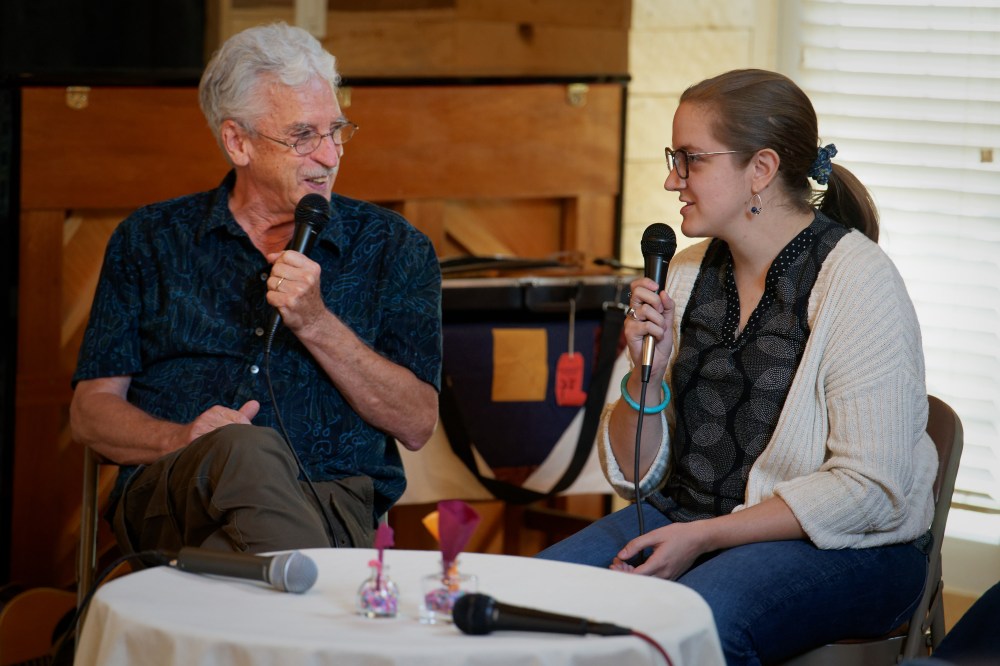
“Although we play old time music and there’s all this kind of interest in what it sounded like in the past…it’s always going to change. Nobody plays like Edden Hammons anymore. Even his nephew who learned from him doesn’t play like him and I don’t have a problem with that and music is always going to change.” — Gerry Milnes
To Gerry and Annick, this apprenticeship isn’t just about learning these tunes, techniques, and stories. It’s also about recognizing they are part of a living tradition. It was important to Annick—who lives on the edges of so many musical genres—to reflect on her own role within this tradition. Through this apprenticeship, she had the opportunity to build relationships with not only the people and places these tunes came from but the people who still play these tunes today. And—just like Gerry did—she is learning how to make these tunes her own while honoring their history.


About the Author
Mary Linscheid holds a B.A. in English (Creative Writing) and minors in Appalachian Music and Appalachian Studies from West Virginia University. She has written articles for Goldenseal Magazine and Journal of Appalachian Studies, and has had poetry published in WVU’s Calliope and the Anthology of Appalachian Writers (vol. XVI). Her band—The Shoats—won the Neo-Traditional Band Contest at the Appalachian String Band Festival in 2023 and continues to perform widely and release music.
Featured interview quotes, recordings, photography, and videos are produced by the West Virginia Folklife Program.


The West Virginia Folklife Apprenticeship Program is supported by the National Endowment for the Arts and the West Virginia Humanities Council.
Read the 2022-2023 West Virginia Folklife Apprenticeship Program featured blog posts linked below:
- Fiddle Repair with Chris Haddox & Mary Linscheid, written by Mary Linscheid
- Old-Time Fiddle with Gerry Milnes & Annick Odom, written by Mary Linscheid
- Clawhammer Banjo with Joe Herrmann & Dakota Karper, written by Mary Linscheid
- Appalachian Storytelling with Bil Lepp & James Froemel, written by Adam Booth
- Mushroom Foraging with Sharon Briggs & Anthony Murray, written by Emma Goldenthal
- Soul Food Cooking with Xavier Oglesby & Brooklynn Oglesby, written by Emma Goldenthal
- Fiber Arts with Enrica McMillon & Barbara Weaner (Featured in Fall 2023 Goldenseal), written by Jennie Williams
 wvfolklife.org