
2022-23 Folklife Apprenticeship Feature: Clawhammer Banjo with Joe Herrmann & Dakota Karper
Written by Mary Linscheid
This article features one of seven pairs supported by the statewide West Virginia Folklife Apprenticeship program in 2022-2023
Now through August 26, 2024, apply for the 2024-2025 program!
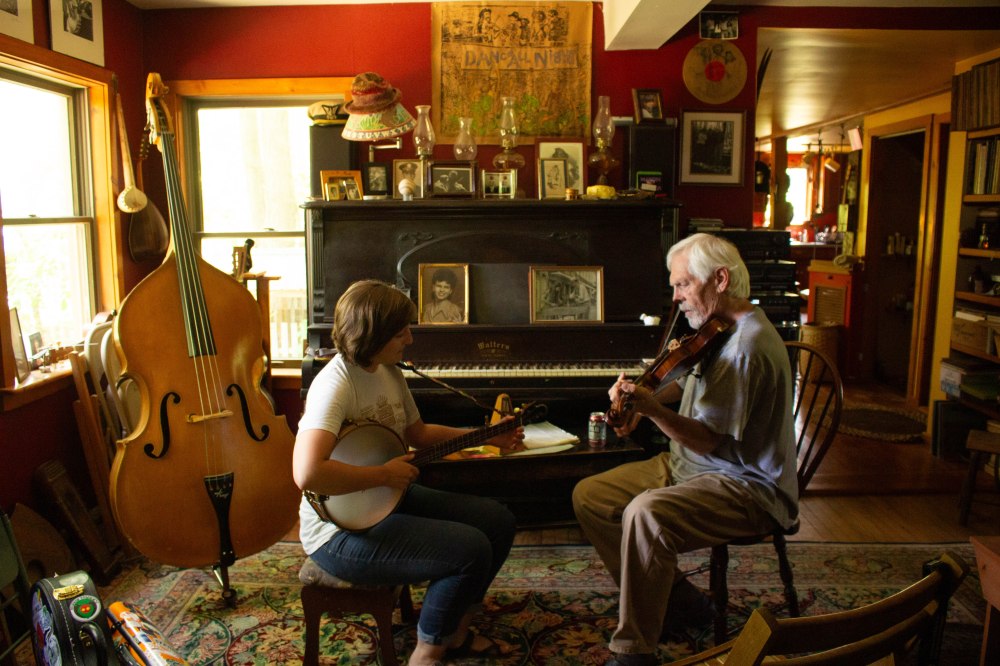
The 2022-2023 round of the West Virginia Folklife Apprenticeship Program was not Joe and Dakota’s first rodeo. Dakota Karper (Hampshire County) had previously studied old-time fiddle with Joe Herrmann (Hampshire County) for two separate apprenticeships, the most recent being the 2020-2021 round of the same program. But this time was different: instead of old-time fiddle, their focus was old-time clawhammer banjo tunes and techniques. She and Joe have been friends since Dakota first studied fiddle with him at ten years old through the former apprenticeship program at the Augusta Heritage Center.
“It was nice starting this apprenticeship already feeling comfortable making mistakes in front of Joe.” — Dakota Karper

The inspiration to study the clawhammer banjo came to Dakota when she was struggling to write a song. After a failed attempt to write it on the fiddle, she picked up the banjo her father made and finished the song within fifteen minutes despite her limited knowledge of the instrument. Dakota—born in 1992 in Points in Hampshire County—grew up surrounded by Appalachian old-time music and a passion for the fiddle. Today, she runs her own traditional roots music school called The Cat and The Fiddle in Capon Bridge. Dakota recently established the Cacapon Music and Dance Foundation, a non-profit organization.
Joe Herrmann—born in Baltimore, Maryland, in 1949—began playing banjo in 1961 with a folk music band whose lead singer, Caroline Mignini, went on to win the “Miss Teenage America” pageant due to her singing talent. Along the way, Joe became interested in rock and jazz guitar, eventually apprenticing with Baltimore jazz icon Larry Wooldrige. In 1974, Joe sold all his electric instruments and moved to Critton Holler, West Virginia, with a single acoustic guitar. Desiring to play the banjo again, he tried to buy one at an auction but was outbid. The next day, he showed up at the winner’s house and they struck a deal: the winner got $50 and a batch of Joe’s homemade beer, and Joe got the banjo.

Joe’s immersion into traditional Appalachian old-time music continued to deepen as he got to know his West Virginia community, playing tunes and making friends with folks such as Jack Schaffenaker, Michael Kline, Kelton Roten, and Israel Welch.
“I never approached a situation like that to get their music. I just wanted to be with [them] and it was the stories, and the conversation, and the friendship. We became really good friends. That was the primary value.” — Joe Herrmann

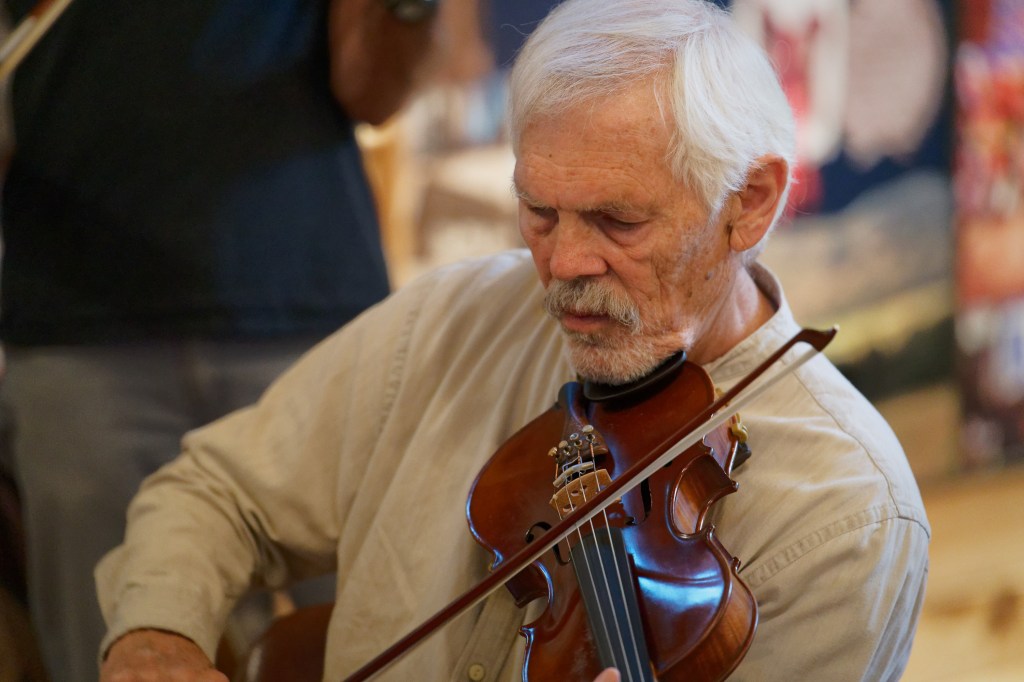


It was upon this ethos that Dakota and Joe founded their own apprenticeship which stemmed from their already well-established friendship. They approached learning old-time clawhammer banjo tunes and techniques as a holistic experience and not necessarily as a structured session.
“I get to go to Joe’s house, where we are going to sit, and we’re going to work, and think, and talk music until we’ve come to a point where we’re happy with how much we’ve thought, and talked, and played music … You may not think of it as a lesson plan, but that is such a good way of imparting music and musical culture in an organic way.” — Dakota Karper

Through this imparting of music and musical culture, Joe and Dakota worked on a wide range of tunes and techniques all centered around the banjo, from the clawhammer “boom-ditty” rhythm in the right hand and all the variations that entails, to learning ways to transpose a tune up the neck of the banjo. Joe views the clawhammer banjo as a unique instrument whose job is to fill a space that only a banjo can fill in a musical setting. Although the banjo can emulate a lot of the things other instruments do—such as play the melody like a fiddle or provide rhythm like a guitar—it can only go so far. Playing all the notes of a tune like a fiddler would is nearly impossible on the clawhammer banjo and it becomes a creative process for the banjo player to decide which notes to keep and which notes to leave out. In contrast, the banjo can incorporate rhythmic elements into the musical setting that cannot be done on the guitar, such as the clawhammer “cluck”—a percussive sound made by a downstroke on the lead string with two fingers instead of one.
“Never sacrifice rhythm to gain melody when you’re playing the banjo because that rhythm, it needs to maintain that persistence. And if you start getting too technical about finding melody, you might end up sacrificing that rhythm.” — Joe Herrmann
As a music teacher herself, Dakota was not only interested in the techniques she was learning, but also in Joe’s methods of teaching. She noted that Joe did not “clog up” his teaching with too many words, creating more confusion than clarity. Instead, he let the banjo speak for itself and challenged Dakota to trust her ability to learn aurally and visually.
“Of course I want to be a good banjo player myself, but to be able to take the things Joe’s shown me and also continue to give that to other people, that’s been an impactful thing for me to have as part of all this.” — Dakota Karper
Recognizing the importance of learning and playing music with each other, Joe and Dakota saw the apprenticeship program as an opportunity to be even more intentional about doing so. For them, growing together musically goes hand-in-hand with growing together as friends and as a community. Although their formal apprenticeship has come to a close, Joe and Dakota remain an example of how musical traditions bring people together and keep them together.

About the Author
Mary Linscheid holds a B.A. in English (Creative Writing) and minors in Appalachian Music and Appalachian Studies from West Virginia University. She has written articles for Goldenseal Magazine and Journal of Appalachian Studies, and has had poetry published in WVU’s Calliope and the Anthology of Appalachian Writers (vol. XVI). Her band—The Shoats—won the Neo-Traditional Band Contest at the Appalachian String Band Festival in 2023 and continues to perform widely and release music.
Featured interview quotes, recordings, photography, and videos are produced by the West Virginia Folklife Program.


The West Virginia Folklife Apprenticeship Program is supported by the National Endowment for the Arts and the West Virginia Humanities Council.
Read the 2022-2023 West Virginia Folklife Apprenticeship Program featured blog posts linked below:
- Fiddle Repair with Chris Haddox & Mary Linscheid, written by Mary Linscheid
- Old-Time Fiddle with Gerry Milnes & Annick Odom, written by Mary Linscheid
- Clawhammer Banjo with Joe Herrmann & Dakota Karper, written by Mary Linscheid
- Appalachian Storytelling with Bil Lepp & James Froemel, written by Adam Booth
- Mushroom Foraging with Sharon Briggs & Anthony Murray, written by Emma Goldenthal
- Soul Food Cooking with Xavier Oglesby & Brooklynn Oglesby, written by Emma Goldenthal
- Fiber Arts with Enrica McMillon & Barbara Weaner (Featured in Fall 2023 Goldenseal), written by Jennie Williams
 wvfolklife.org