
Legends & Lore Marker Grant Program Seeking Applications
Application Deadline: April 29, 2024
Next window to apply: August 26, 2024 – October 14, 2024
The William G. Pomeroy Foundation is accepting applications for its Legends & Lore Marker Grant Program. The program highlights local folklife and promotes cultural tourism in the participating states in the United States.
See the Pomeroy Foundation’s website for more information about how to apply and if your organization is eligible!
This guest post is written by AmeriCorps member Vanessa Peña who serves with the West Virginia Folklife Program at the West Virginia Humanities Council.
I think this program is a great cultural highlight for communities. Before starting my AmeriCorps service with West Virginia Folklife, I always knew about folklore but never knew how to put it into words. So far, I have learned there is interesting folklore among each community we’ve visited and every friendly person we’ve met. Traditions from family recipes to storytelling, even about cryptids like the Mothman and the Grafton Monster. I feel passionate about this program because I want local folklore to be celebrated in a meaningful way.
The Legends & Lore markers exhibit three main categories: folktale, legend, or folklife. Qualifying proposals typically center on community-based stories and traditions over individual or family-specific stories. I explored the 18 Legends & Lore markers found throughout West Virginia on the marker map and share my favorites that may serve as examples for future marker proposals.

“Aunt Jennie Wilson”
Logan County
Visit the latest Legends & Lore marker installed in West Virginia recognizing Aunt Jennie Wilson (1900-1992), whose legacy lives on through her family, the Aunt Jennie Wilson Music Festival, and many field recordings. She was a clawhammer banjo player, storyteller, and ballad singer from Logan County. The marker now stands at Chief Logan State Park nearby where she was born.
Musician and WVU professor Chris Haddox researched several musicians as part of the Folk Music of the Southern West Virginia Coalfields project. He writes that Aunt Jennie Wilson began learning tunes on the banjo at square dances and gatherings at a young age. “She also learned tunes and tunings from black and white banjo players who came by the Ellis farmhouse when she was a child,” Haddox explains. “At the same time, she was learning to sing ancient British Child ballads, nineteenth-century American ballads, songs derived from Black tradition, and several historical ballads about events in Logan County, where she was born and lived her entire life. She learned many of these from her mother and sisters; she would sometimes sing them unaccompanied and sometimes accompany herself on the banjo.”
In 1984, Aunt Jennie received the Vandalia Award, which is the highest folklife honor in the state of West Virginia. Read more about Aunt Jennie Wilson and Chris Haddox’s research here.
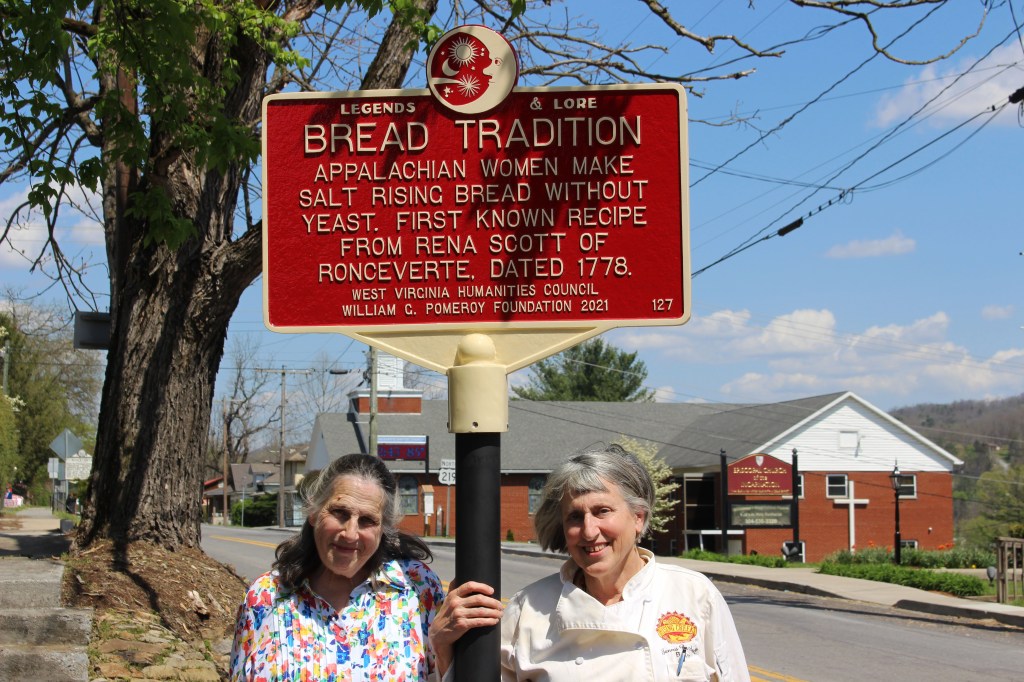
“Bread Tradition”
Greenbriar County
If you travel to Ronceverte, you will find the Legends & Lore Marker honoring the Appalachian salt rising bread tradition. Salt rising bread recipes have been passed on for generations in the region. The naturally fermented bread is recognized for its dense crumb and “cheesy” flavor. Bakers and historians Jenny Bardwell and Susan Ray Brown have studied a few theories about the origins of salt rising bread and published a book, Salt Rising Bread: Recipes and Heartfelt Stories of a Nearly Lost Appalachian Tradition (2016). Rena Scott of Ronceverte is credited with providing the earliest known recipe for Salt Rising Bread in The Greenbrier P.E.O. Cookbook, and the “Bread Tradition” marker honors this history.
I enjoy learning about food traditions because food brings people together. Everyone eats, and so everyone has a story related to food and recipes. Food traditions typically carry on and develop overtime when for example communities migrate or access to ingredients change. There are countless recipes and stories shared in families and Appalachian communities about salt rising bread, and the special tie to Ronceverte makes this a great tradition to celebrate with a Legends & Lore marker.
In 2018, the West Virginia Folklife program supported an apprenticeship between Jenny Bardwell and Susan Ray Brown and their apprentice Amy Dawson of Lost Creek. Read more about their apprenticeship and the Salt Rising Bread tradition here. Learn more about the tradition by watching The History and Science of Salt Rising Bread.

“Wizard Clip”
Jefferson County
A Legends & Lore marker located in the eastern panhandle in Middleway recognizes the Wizard Clip, a local ghost story from the late 18th century. The story centers on Adam Livingston who experienced paranormal occurrences on his home and farm. As one version of the story goes, the haunting activity began following a visit from a stranger who became ill and died at the Livingston home and who was then buried nearby unceremoniously. Animal deaths, noises, and disturbances occurred. The most persistent of which was the sounds of shears clipping, and the discovery that their clothing and fabrics would be cut up in the shapes of crescent moons. Although he was Lutheran, Livingston had a dream about a man in robes who he later believed was a Catholic priest. He requested a priest from Shepherdstown to come to his home. The supernatural phenomena then ceased, all except for the sounds of a voice that visited the Livingston family. Livingston would convert to Catholicism and donate a portion of his land to the Catholic church.
I personally love a good ghost story and am very interested in the supernatural and the paranormal. The Wizard Clip is a great example of a legend, a story passed down through generations perhaps parts of which based in historical fact, though not verifiable.
From Logan to Jefferson Counties, the folklore from our state makes me proud to be a West Virginian. I enjoy learning about how resilient people can be and about the traditions we value and carry on.
Consider these examples if you would like to apply for a Legends & Lore marker! Perhaps there was a supernatural event that cannot be explained in your town or a traditional practice that persists and carries importance for your community. Before you apply, question if your proposal is purely a literary creation, historical event, or personal family folklore—these proposals will not be successful if they do not carry folkloric elements relevant to a greater community.
The application window opens twice a year for a Legends & Lore grant. Reminder the spring deadline is April 29, 2024. For more information about this grant and its guidelines, visit Legends & Lore® Marker Grant Program | William G. Pomeroy Foundation. If you are interested in applying, we encourage you to contact state folklorist Jennie Williams at williams@wvhumanities.org or (304)346-8500 to discuss your application and to answer any questions.
 wvfolklife.org