
This article is published in the Summer 2023 issue of Goldenseal Magazine. It is written by West Virginia State Folklorist Jennie Williams and edited by Laiken Blankenship.
“Appalachian Soul Man” Aristotle Jones (b. 1979) is a professional musician and radio personality who is carrying on his music tradition in Osage where his grandfather and extended family have lived. He grew up in Huntington and moved throughout his life, living in Berea, KY, Morgantown, and Point Marion and Smithfield, PA before moving back to West Virginia. His breadth of experience living in Appalachia is reflected in the stories he shares in his songwriting and on stage during his performances. Since 2019, he has released several singles under his name with his band, and in 2021, he released his first album Appalachian Soul Man. This article highlights excerpts from an interview Aristotle gave with West Virginia Folklife in which he discusses his relationship with his granddad, Robert Alfonsi Jones. Aristotle credits his love of music to his granddad. Our interview is part of an ongoing project to document living folk and traditional creative practices of the Scotts Run community in Monongalia County. The project is made possible in part by West Virginia Folklife partner organization Mid Atlantic Arts and their Central Appalachia Living Traditions program.
“My grandfather was a coal miner, very conservative Christian man, kind of like, imagine John Wayne if he was a Black Appalachian man. Huge hands, big old knotty knuckles, and my grandmother [Daisy Jones] was a farm wife, but she was the boss.” Aristotle’s grandfather owned a farm in Osage, West Virginia but when he and his family were displaced in 1971 when I-79 was built, he began farming 102 acres just across the border in Smithfield, PA. Aristotle spent his summers with his grandparents, “bringing in hay, riding horses, four wheelers, learning how to farm, raising pigs… no one that I knew was doing the same things exactly, so it kind of gave me this background where I thought maybe we were weird people ‘cause I didn’t see any Black farmers, I knew my granddad and that was it.” To reinforce Aristotle’s confidence, his grandfather would remind him to “just be yourself, you know what you’re doing.”
Music and his grandfather’s influence has helped shape Aristotle’s identity as a Black man from West Virginia, and he shares his experiences with his audiences. “I’m telling these stories when I’m out at my shows to let people know that Appalachia is a place of intersectionality, and you can be all of these things.” Inspired by the 1885 state song, Aristotle’s “West Virginia Hills” (2019) is an embrace of his West Virginia identity. “I’m a proud ambassador of West Virginia so when I travel outside of the state and I’m playing, [I’ll say] ‘I’m Aristotle Jones, the Appalachian Soul Man, I’m from West Virginia. For those of you guys who don’t know what Appalachian soul is, here’s a few songs that maybe will give you an idea.’” Aristotle follows in the tradition of Black R&B and soul bands that were prevalent in many rural Black communities in the region during the mid-20th century, including Bobby Nicholas of Morgantown and Al Anderson of Osage. Growing up listening to soul, blues, gospel, and R&B with his grandfather, Aristotle’s recordings and live performances with his band feature instrumentation common in these styles including a brass section, drums, bass, and both acoustic and electric guitars to fill out the sound supporting his affective vocals and storytelling.
Aristotle’s grandfather had a shot at singing and touring professionally, but he had to forgo the opportunity because, like many Appalachians, he was providing for a family at the time and working in the mines. “My grandfather was a singer, and he was a gospel singer, and so we would play music and he gave me my first harmonica… I still didn’t know that was a big part of his life, I just kind of heard stories from people.” Aristotle explains that his grandfather would encourage him to be creative. “Music was something that always called to me, I kind of knew from a young age. I would sit at the bus stop and make up songs and I wanted to play the saxophone and it was just something that was in me. Nobody really understood it because the only other person that I knew that was any kind of musician was my granddad.” Aristotle vividly remembers singing “Tomorrow” by the gospel and R&B group The Winans when he was six or seven years old for his grandparents, and his granddad said, “You know, I can sing too.” Aristotle would listen to him sing on his tractor while picking up hay. “You’d sit up on the wheel and we’d ride along just smiling, he would drive, and he’d try not to hit ruts and knock you off, but he would sing while he was working… I knew he could sing, I never even thought about it like as being a singer, I just thought that’s what you did.” His granddad especially enjoyed singing with his band The Gospelaires. They toured to towns including Petersburg, Fairmont, and others throughout north-central West Virginia performing for Black coal camp communities in the 1960s and ‘70s. When his grandmother passed in 2016, Aristotle moved in with his grandad to spend time with him and to help him on his farm in Smithfield.
Living together allowed for their relationship to mature and grow close as Aristotle took on a caretaker role at the farm. Though he felt removed from the lifestyle he had before making music with his band, Aristotle and his granddad spent their time together singing, watching old Western films, and sharing stories. They would often perform together at church services, retirement communities, and at the annual Scotts Run Homecoming Street Fair. The street fair is a reunion for those who have been displaced or moved away over the years to come back and visit Scotts Run and share their stories. Aristotle has attended the event for the past seven years, and each time he learns more about the history of his community. He wrote “Get What you Give” (2021), a song about a couple in love and growing stronger together, reflecting on his grandparents and their generosity towards their neighbors.
Aristotle’s relationship with his grandfather and the music they shared grounded his sense of identity and belonging. “Living with my granddad gave me a place where my history was here.” Aristotle’s grandfather Robert Jones died on November 28th, 2019. Aristotle now lives on the same street as the Scotts Run Museum, steelpan studio Mannette Musical Instruments, and soul singer Al Anderson’s shoe repair shop in Osage. He has inherited an impassioned interest in learning about his family roots in the community, carrying on the regional music tradition he learned from his granddad, and telling the story of Osage. In 2020, Aristotle began exploring musical styles of “what I thought my granddad would have been listening to whenever he proposed to my grandmother, the music my dad would have been listening to when he was living here with my mom, the music that would have been on the streets at any point in time.” His album titled Mountain Doo-Wop in the Streets of Osage will be released in late 2023. Aristotle writes about love in the midst of struggle. Of romantic love, of love between family and community, and love for a higher power, and love for yourself.
Through his music and by working in radio, Aristotle wants to set an example for a younger generation of people who live in his community and to instill in them a sense of pride for living and creating here in West Virginia. “We have everything right here and we have us, and we have anybody who’s listening. We have future generations, hopefully what we can do instead of just climbing mountains, we can build mountains.”
Listen to Aristotle Jones’s music, find his tour dates, and listen to his radio show podcast Sounds Good to Me with Aristotle Jones at https://www.aristotlejones.com/
To learn more about the Scotts Run Museum and its history go to http://scottsrunmuseumandtrail.org/
Read more about the Scotts Run Resonance Project and follow the Scotts Run Resonance Facebook Page to attend upcoming events.
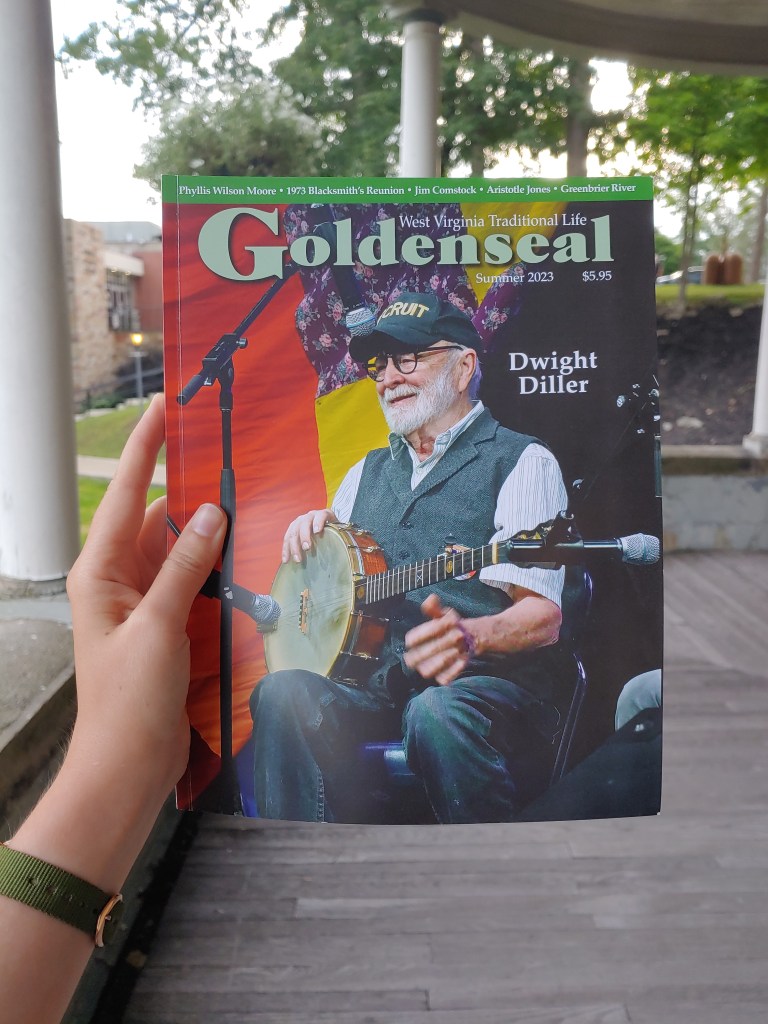
To receive a print version of this issue, see the West Virginia Department of Arts, Culture, and History website to learn more.
Featured photo of Aristotle Jones was taken by Jennie Williams at the West Virginia Humanities Council in Charleston on November 28, 2022.
 wvfolklife.org