
Stories of Community and Fasnacht from Helvetia, West Virginia
Written by Vanessa Peña, Landon Priddy, and Jennie Williams
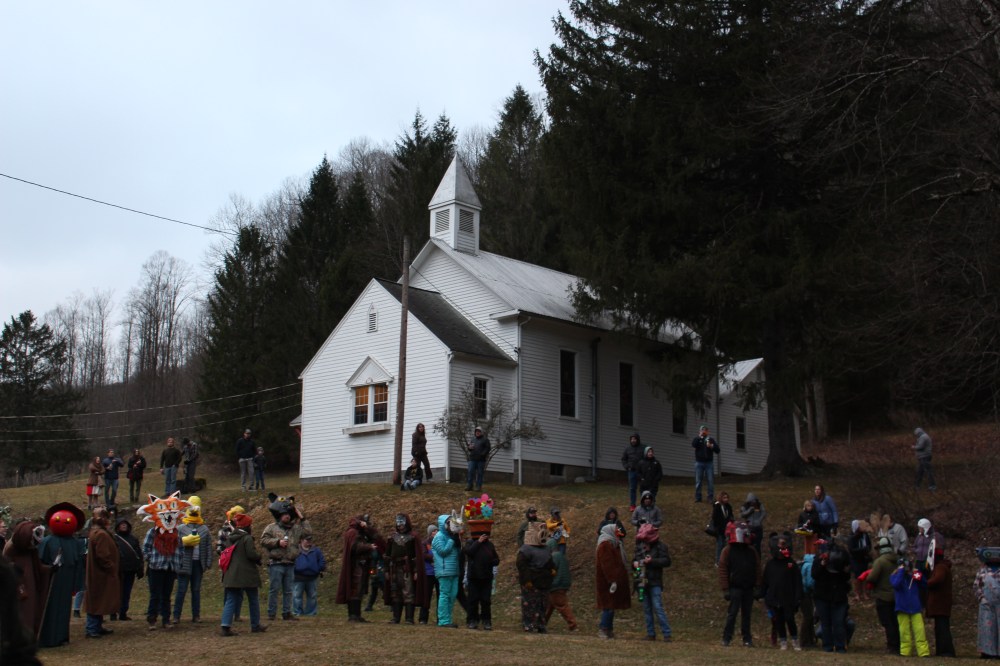
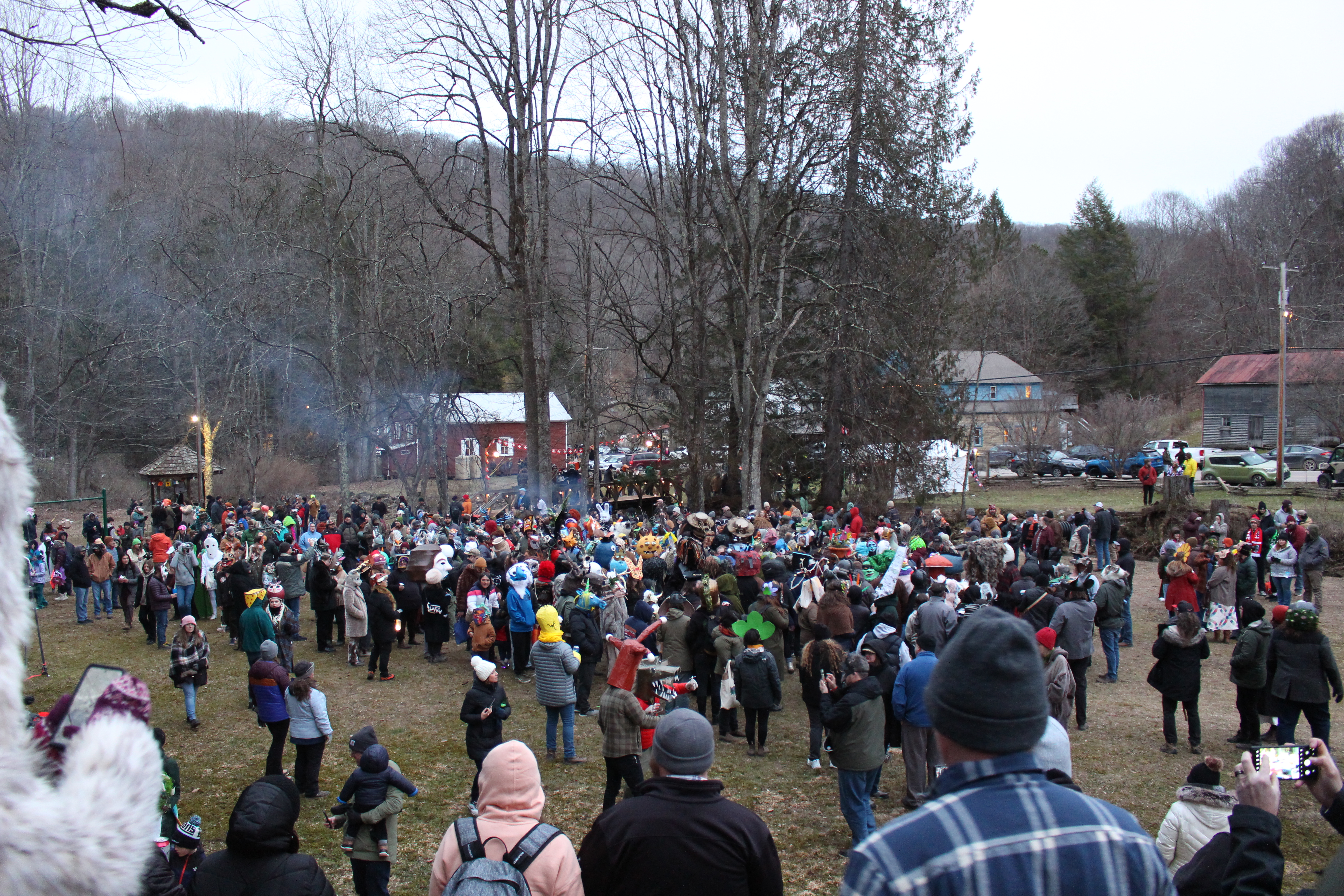
On Saturday, March 1, 2025, visitors in winter coats and elaborate handmade masks gathered with locals for Helvetia’s community-wide Fasnacht celebration. As part of the event, a rapt crowd filled the pews of the town’s Zion Presbyterian Church to hear Heidi Fahrner Arnett, Eleanor Betler, and Maura Hofer share personal stories about what it was like to grow up in Helvetia and their memories of the festival’s early years.
Heidi, Eleanor, and Maura are dedicated to preserving the history of their home. Helvetia is a small town in Randolph County, West Virginia, settled by Swiss immigrants in 1869. The three women work with the Helvetia Restoration and Development Organization (HRDO) to prepare for the town’s renowned Fasnacht festivities, which attract approximately one thousand visitors. In preparation, Heidi, Eleanor, and Maura work with HRDO to maintain and make available their community archives, cook traditional food, upkeep facilities, and so much more. This discussion allowed for visitors to meet these women behind the festival, to learn about Helvetia’s history and culture, and to appreciate the hard work that goes into making Fasnacht a success each year.
West Virginia State Folklorist Jennie Williams and Director of The Frank and Jane Gabor West Virginia Folklife Center Lydia Warren facilitated the discussion. The following is a summary of highlights from the 2025 panel.
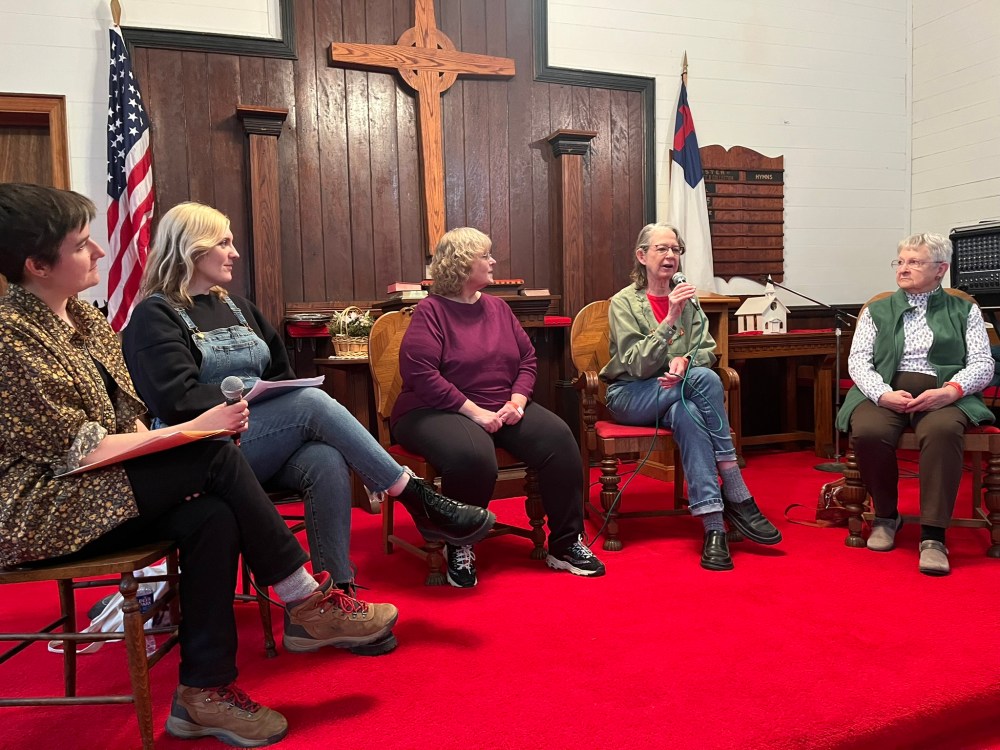
Heidi Fahrner Arnett is a fourth-generation Swiss American living in Helvetia. As a child, Heidi lived on Guam with her family, and she holds rich memories of growing up in both places. Heidi’s mother, Eleanor Mailloux, met Delores Baggerly before returning to West Virginia. Although Fasnacht used to be celebrated at home or with neighbors in more private settings, Eleanor and Delores helped make Fasnacht a public event in the community in 1969 during Helvetia’s centennial year. “It was very small, Fasnacht, in the beginning and mostly community,” Heidi remembers of the festival’s early years. One year, Heidi’s sister invited her college friends to Helvetia to experience Fasnacht. “My mother made two huge batches of sukiyaki, and all the Wesleyan kids came, and they were sleeping on the floor, on the table, underneath the table, in the hallway to the bathroom. There were kids everywhere. It was wonderful, but that was one of the first memories I have.”
Growing up, Eleanor Betler spent her summers in Helvetia at her grandparents’ farm. In 1961, she got married and started her own family at a hilltop farm in Helvetia. During Fasnacht, Eleanor takes the lead in preparing traditional Swiss fried treats, including rosettes and hosablatz, that are then gifted to visitors who pay admission. Eleanor explained to the audience that it is customary to eat rich foods during Fasnacht before Lent begins, just like during Mardi Gras. “There were seven women working from 10 o’clock in the morning until four o’clock in the evening,” she told the audience. “We’ve worked hard all day yesterday to make hundreds of rosettes and hosablatz.” She received a round of applause upon describing the magnitude of this prep work. Eleanor explained that their grandparents made these traditional treats, and recipes can be found in the Helvetia community cookbook, Oppis Guet’s Vo Helvetia.
“We’ve worked hard all day yesterday to make hundreds of rosettes and hosablatz.” – Eleanor Betler
Maura Hofer grew up in Helvetia with her six siblings. Her family descends from the first Swiss babies born in Helvetia. Maura’s first memory of Fasnacht was the first public event that the community hosted in ’69. The annual event in Helvetia is now hosted on the Saturday before Lent, but she remembers the town used to celebrate it on Shrove Tuesday. “Because it was on a Tuesday night and a lot of people had to work, we didn’t have a real big event like we do now,” she reflected. “It was mostly community—the Helvetia community folks, mostly. There might have been one or two people who came down from Pickens… It was a really fun dance, and usually they always were no matter how big or how small just because everybody’s singing, dancing, and having a good time. I remember that year so well because then in the summer, it was the centennial summer, and of course we folk danced all summer long and had big events every single weekend to celebrate.”
LIFE AND COMMUNITY IN HELVETIA
Through the generations, families in Helvetia have relied on traditions and knowledge rooted in Swiss and Appalachian culture to provide for their community. For example, The Hütte restaurant has been a cultural hub centered on traditional cooking for over 50 years. It even had an operating switchboard the community used to place phone calls. “The Hütte is wonderful. And Heidi’s family has sold dinners there for a long time,” Eleanor said. “Her mother [Eleanor Mailloux] worked there all year round, every day.” The Hütte offers traditional Swiss-Appalachian dishes, many of which are from the original families that settled Helvetia.
Located miles away from big towns and accessible by winding roads, Helvetia’s community sustained itself through agriculture and small farms. “Most people farmed, raised big gardens,” Maura said. “I mean, there were nine of us, including my parents, so to have food on the table you always raised big gardens.” Her family canned using half gallon jars while her dad raised two pigs and a calf each year to butcher. “If you had a cow, you made cheese,” Eleanor chimed in. “And with five gallons of milk, you made a three-pound cheese—Swiss cheese. The dairy specialists have told me that our cheese tastes like what our traditional Helvetia cheese was. [It] tasted like the cheese they made in the highest Alps.”
As a close-knit community located far away from larger towns, they would find entertainment through local festivals, dances, and other such celebrations. “Well, for us, fun was Saturday night square dances,” Maura said. “In later years, in the ’70s, we started doing record hops up at Pickens.” According to Maura, they would attend dances at the community hall in Helvetia or at the American Legion in Pickens hosted by different local clubs or organizations. In addition to Fasnacht, Helvetia hosts several annual community events, including a ramp supper in April and the Helvetia Community Fair in September.
STORIES OF FASNACHT IN HELVETIA
According to Eleanor, generations ago, Fasnacht in Helvetia used to be more like Halloween. She explained, “You would go from house to house and beg for some goodies, you know, and that’s just all it was for a long time. And then 100 years later, we decided to make a party out of it.” Eleanor remembers Delores Baggerly’s eccentric costumes: “Mrs. Baggerly did a lot of the artwork, you’ll see in The Hütte and on some of the buildings…She was an artist, and she came to the first Fasnacht dance in costume to parade around. She was dressed [with] an old cat around her neck, and was carrying a candelabra that was lighted, and my kids were so scared. They were sure she was a for real witch.”
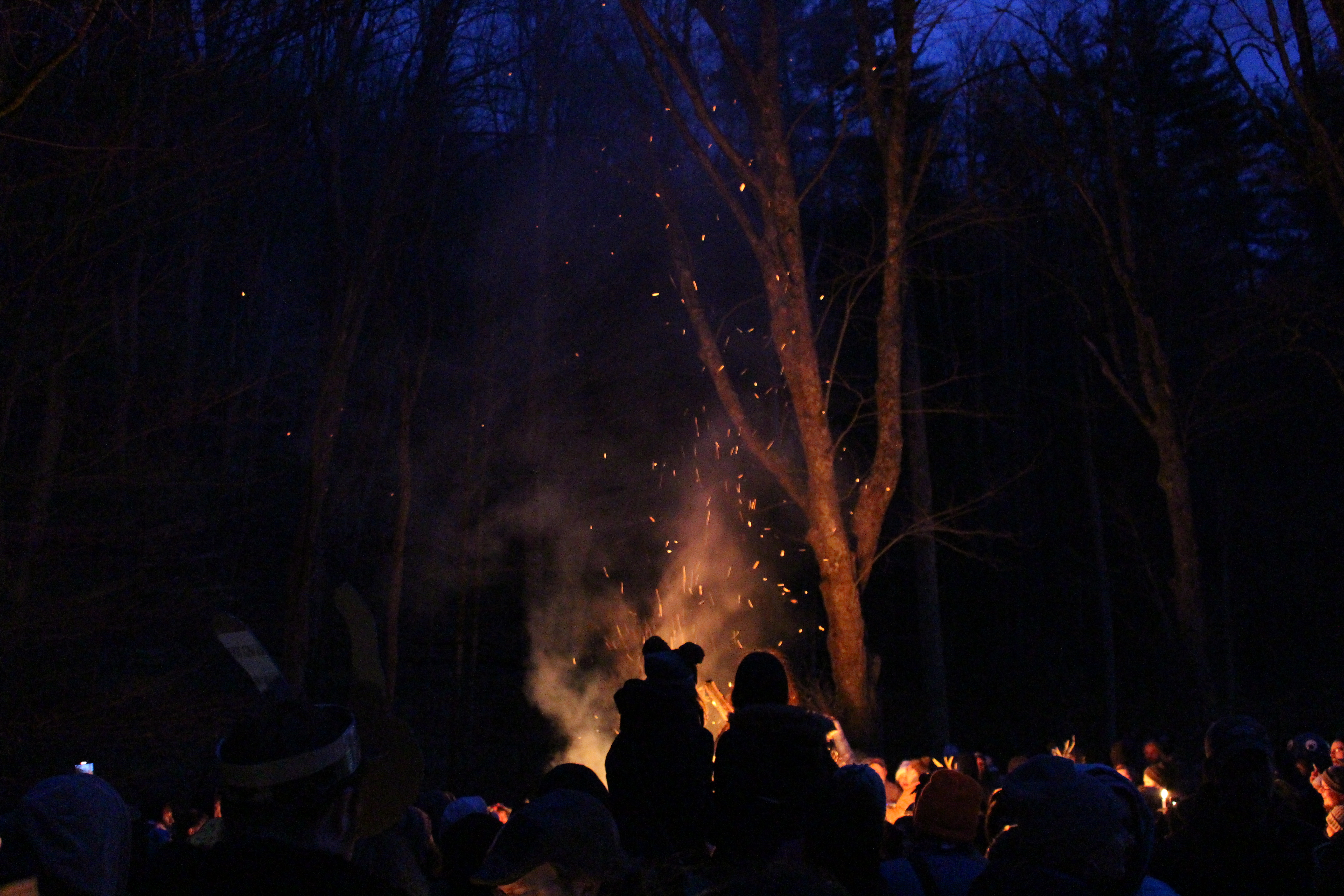
Costumes are a huge part of Fasnacht and a draw for visitors. Attendees make their own masks at home using papier-mâché, chicken wire, cardboard, fabrics, or other materials. Creativity is encouraged during the masquerade and costume contest, and winners of the contest receive small Swiss flags. It’s exciting to witness hundreds of disguised people wearing cleverly designed costumes at night as they parade the effigy of Old Man Winter in its final moments. The parade ends at a bonfire where they toss Old Man Winter into the flames to welcome the coming of spring.
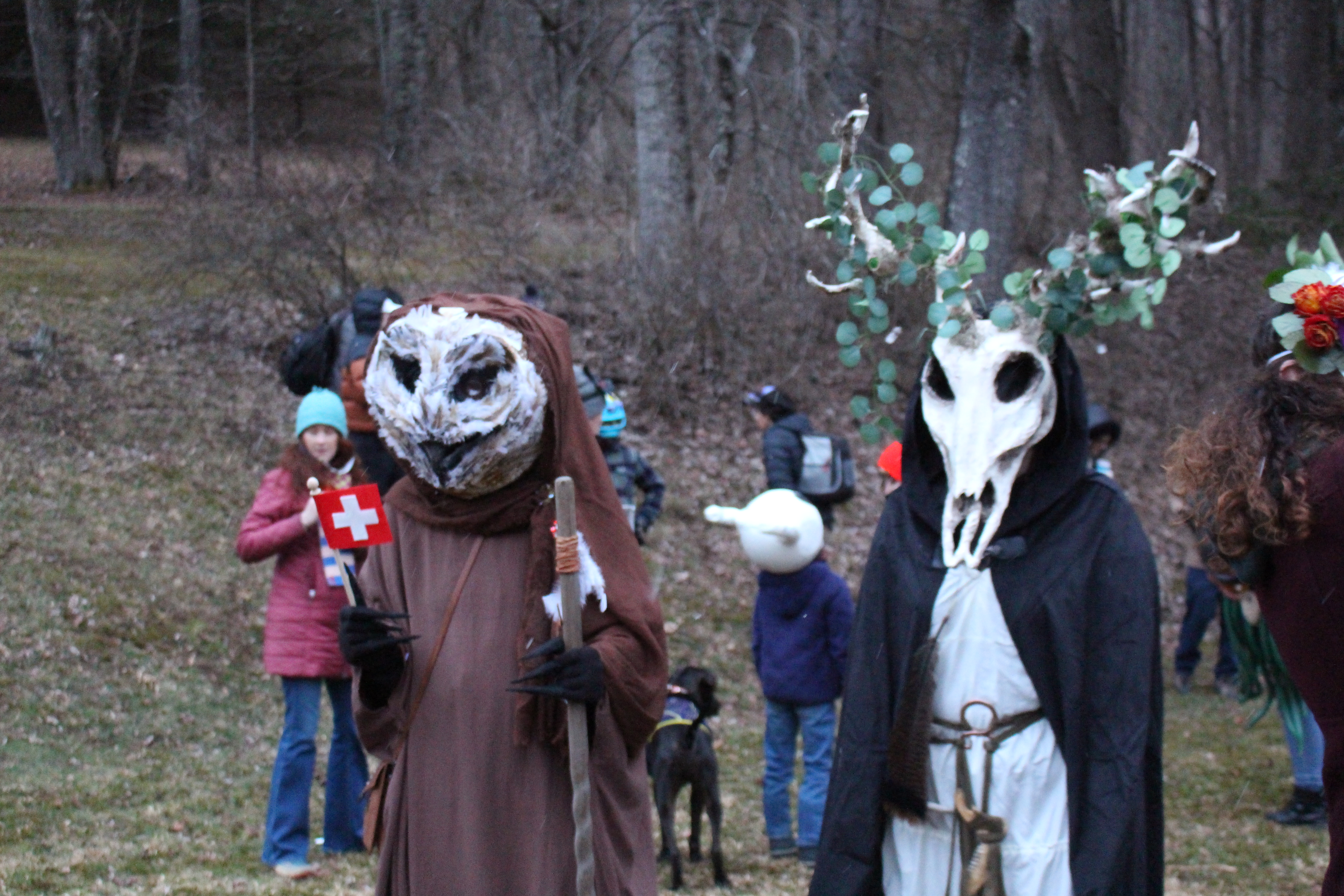
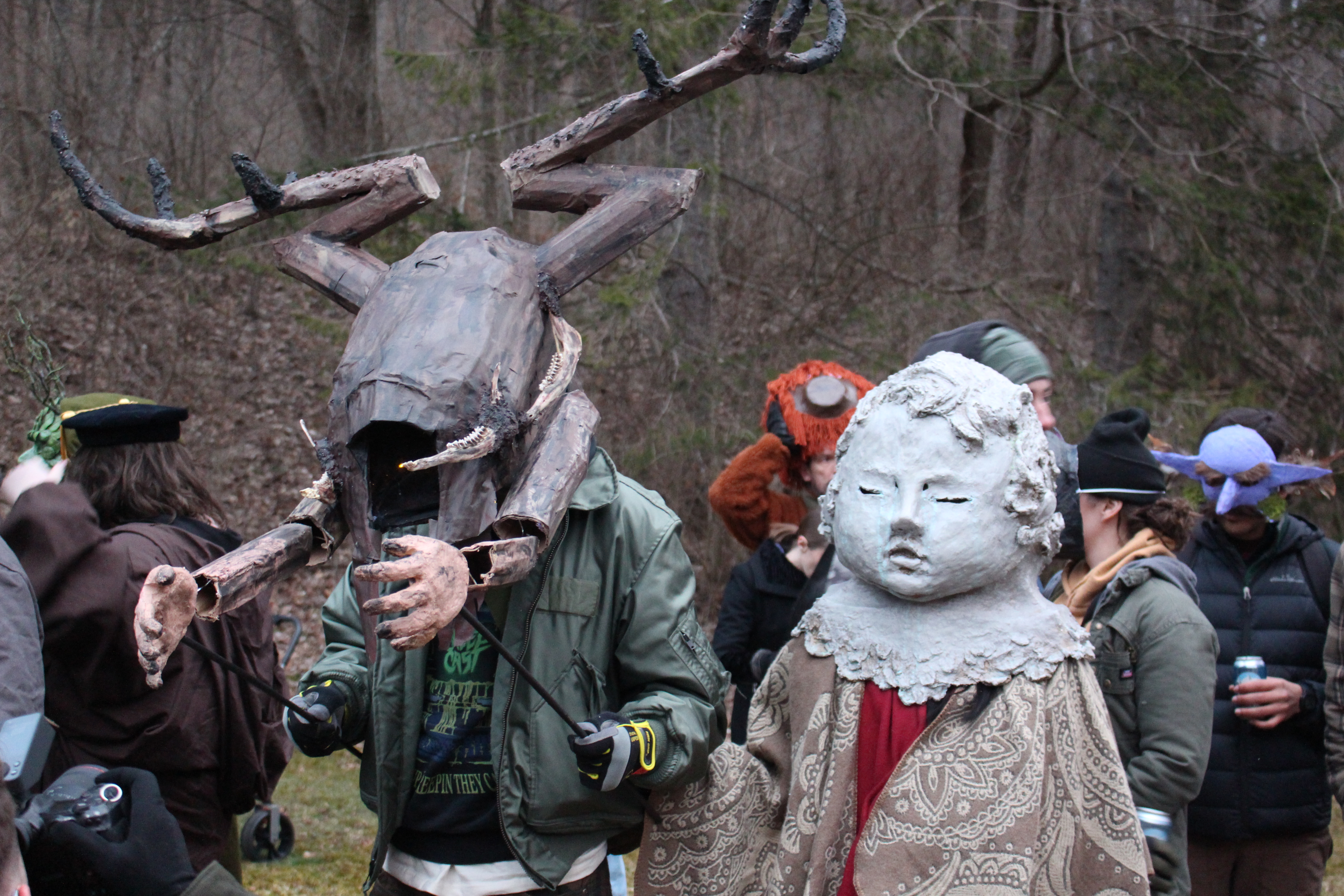
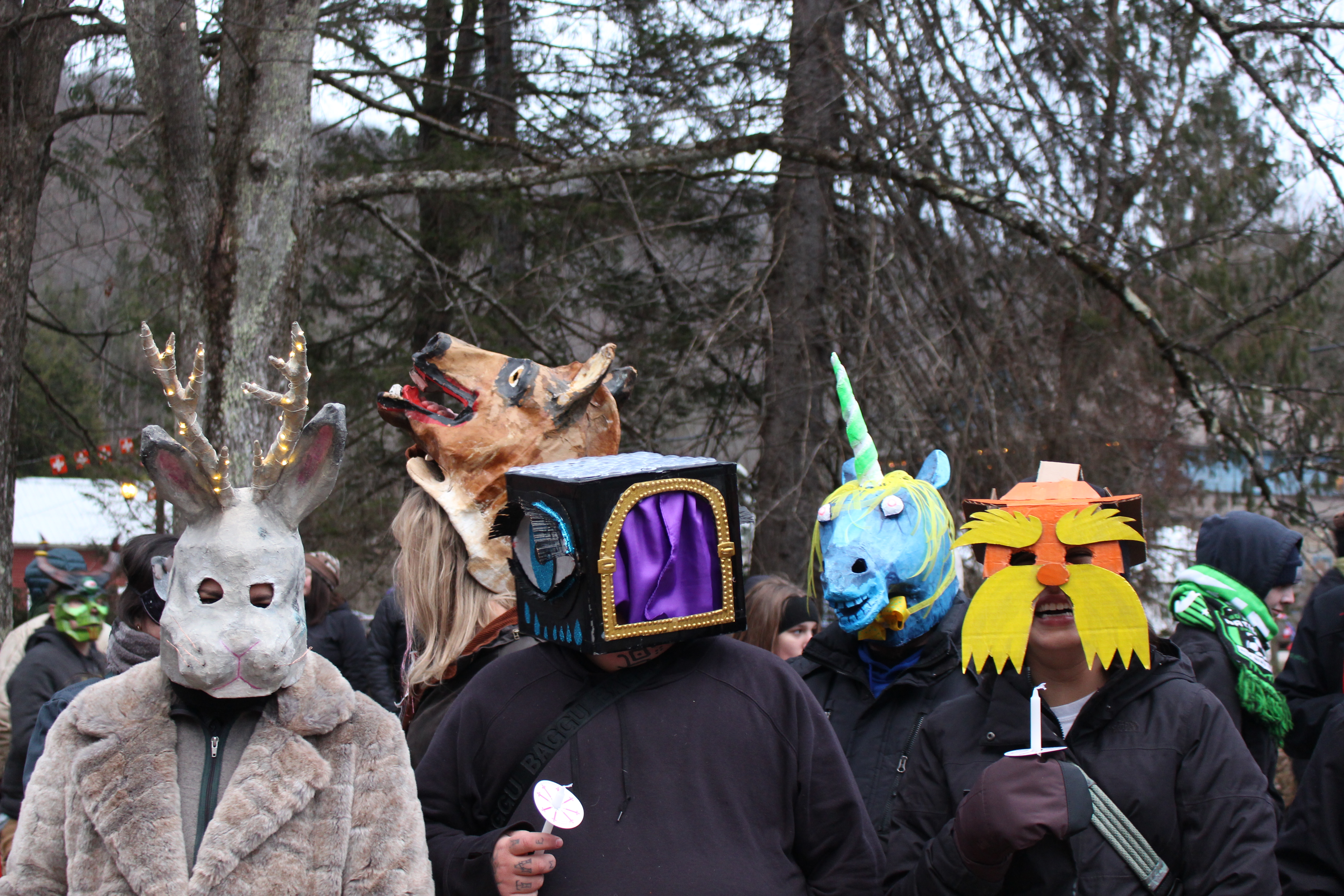
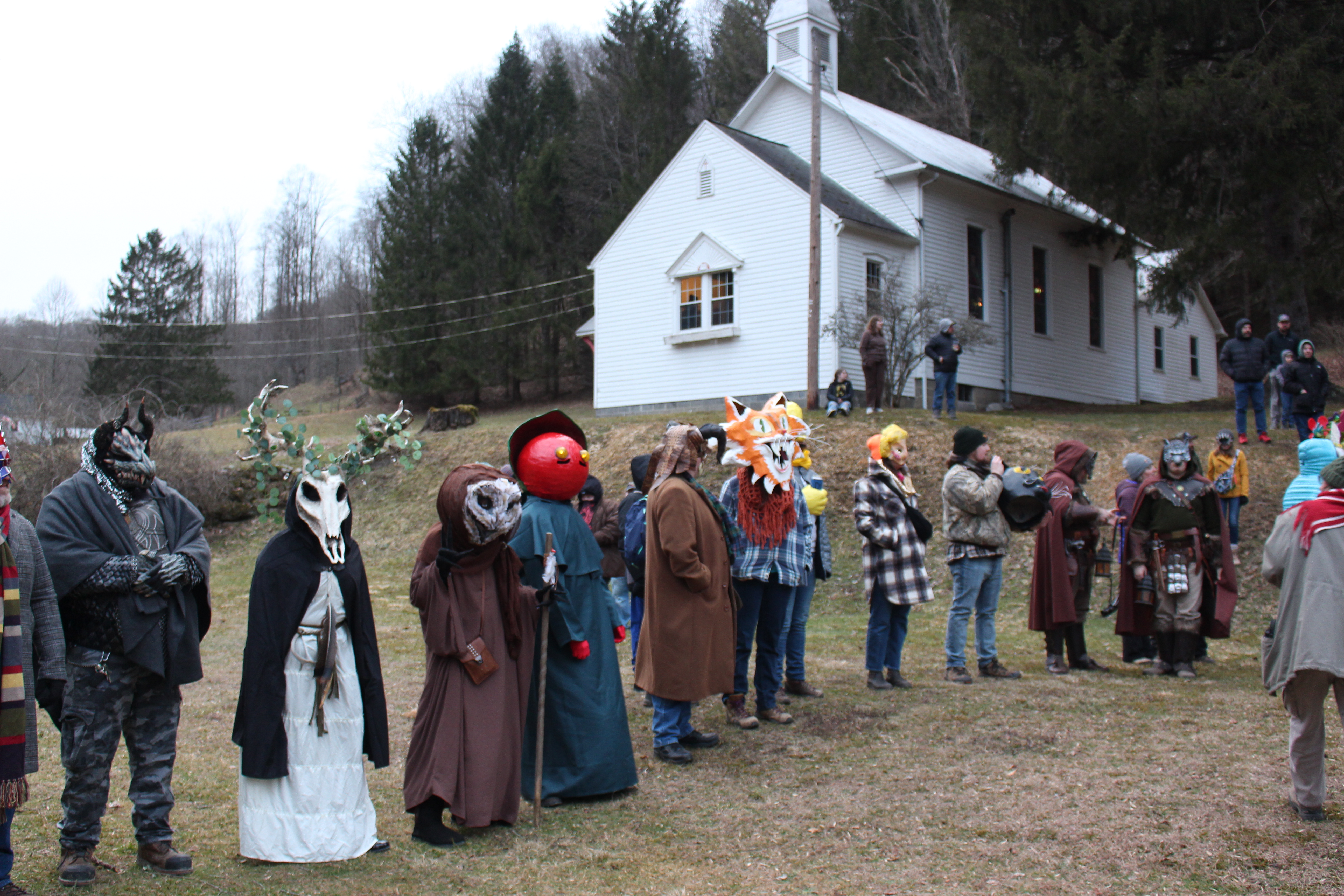
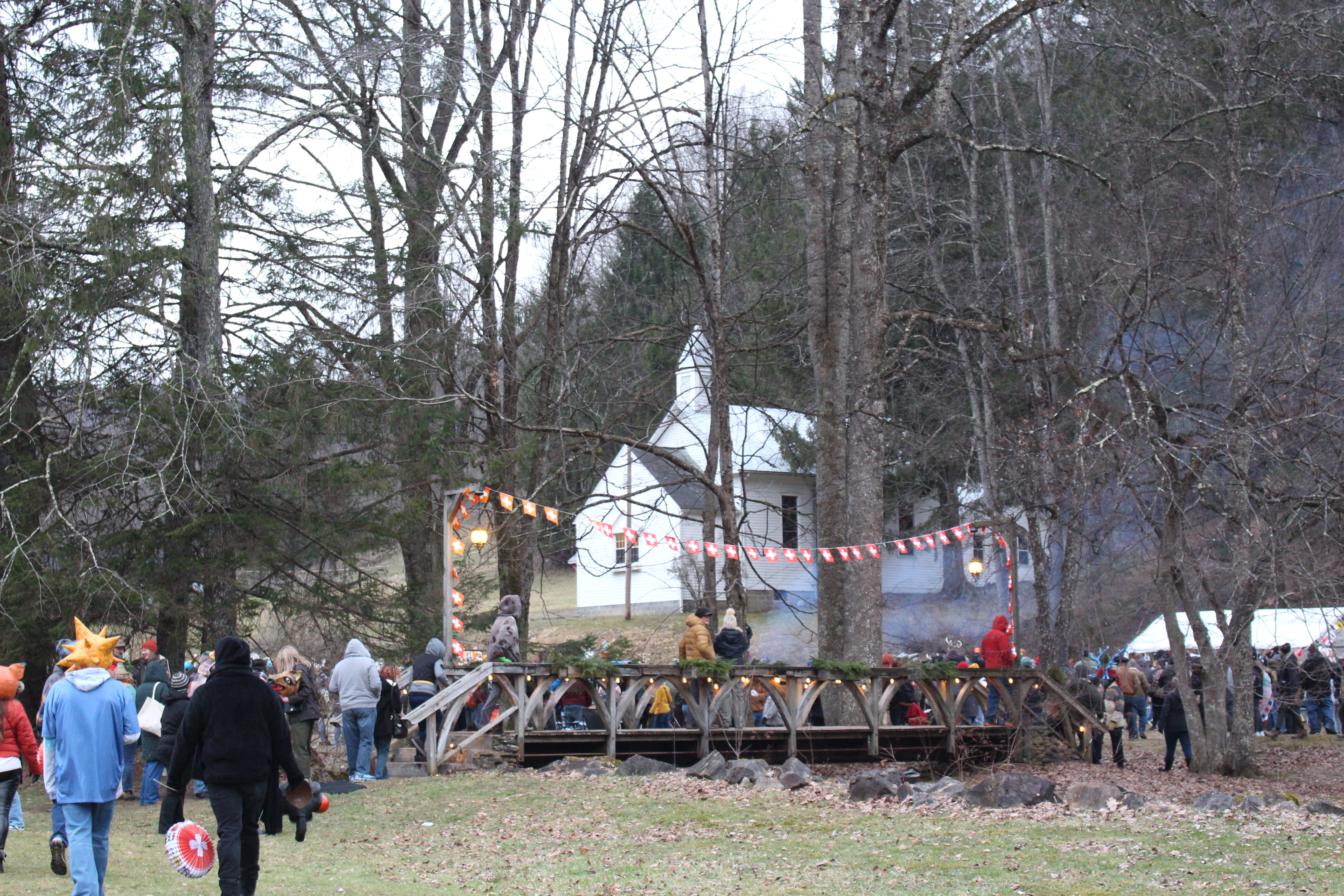
All three women laughed as they remembered a stand-out costume they saw at the dance one year. “I’m looking up, [and] finally, I see a head right up next to the ceiling. And I thought ‘What?’ It was someone on stilts and they were dressed from head to, I mean, from their feet clear up to the ceiling in a costume,” Eleanor recalled. “I was so darn impressed!” Heidi pointed out, “There were stilts and two guys in there!”
The charm and excitement one can experience at Fasnacht has led to a significant boost of interest from visitors in recent years. The New York Times published a feature article about the event in 2022, and several fans of the videogame Fallout 76 now make the trip to attend Fasnacht. “The whole sense of community is so strong…everybody is welcome, and everybody is welcoming, and they’re happy to be here,” Maura said. “People come back year after year and they say, oh, this is my tradition.”
“Everybody here has a heart as big as the mountains.” – Maura Hofer
An audience member asked, “What do you think is important to take away from this community as a visitor?” Heidi responded, “I think there are many people that come to help Helvetia, and it makes me almost cry. There’s something special here, and I think everybody accepts who everybody is. That’s one of the lovely things.” Maura responded, “I think one of the important things to take away though is what you can accomplish as a small community.” She praised the community for its efforts to organize annual events, including Fasnacht and the ramp suppers. Maura continued, “Everybody here has a heart as big as the mountains…if something happened and you needed help, all you would have to do is say, I need help, and anybody around would be very happy to help you.”
Come to Fasnacht on Saturday, February 14, 2026! The schedule and information about how to purchase admission can be found at this link.
We would like to thank Heidi Fahrner Arnett, Eleanor Betler, and Maura Hofer for sharing their stories, to the audience for their respectful attention and questions, and to Clara Lehmann, the Helvetia Restoration and Development Organization, and the volunteers at Fasnacht for making this community conversation possible.
This year, there will be a special Fasnacht discussion panel hosted by local historian Anna Chandler, featuring Maura Hofer, Eleanor Betler, and Mary Gibbons. Together, they’ll explore the history of Fasnacht, its meaning in Helvetia, and its surprising connections to Mardi Gras—especially through Mary Gibbons’ experience growing up in New Orleans. The conversation will touch on ritual, community, food, masking, and how different cultures mark the turning of seasons through celebration and release.
About the Authors:
Vanessa Peña served as an AmeriCorps member at the West Virginia Humanities Council from 2022-2025.
Landon Priddy worked at West Virginia Humanities Council through the Marshall University HerdWork Humanities Internship program in 2025.
Jennie Williams is the West Virginia State Folklorist at the West Virginia Humanities Council.
 wvfolklife.org