
2022-23 Folklife Apprenticeship Feature: Fiddle Repair with Chris Haddox & Mary Linscheid
Written by Mary Linscheid
This article features one of seven pairs supported by the statewide West Virginia Folklife Apprenticeship program in 2022-2023.
NOW through August 26, 2024, apply for the 2024-2025 program!
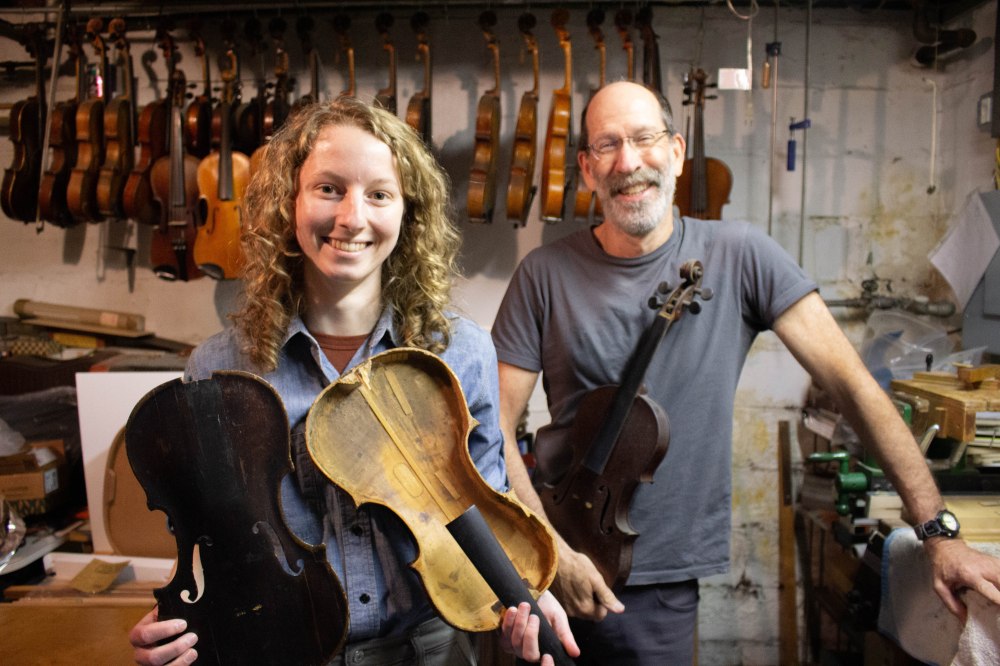
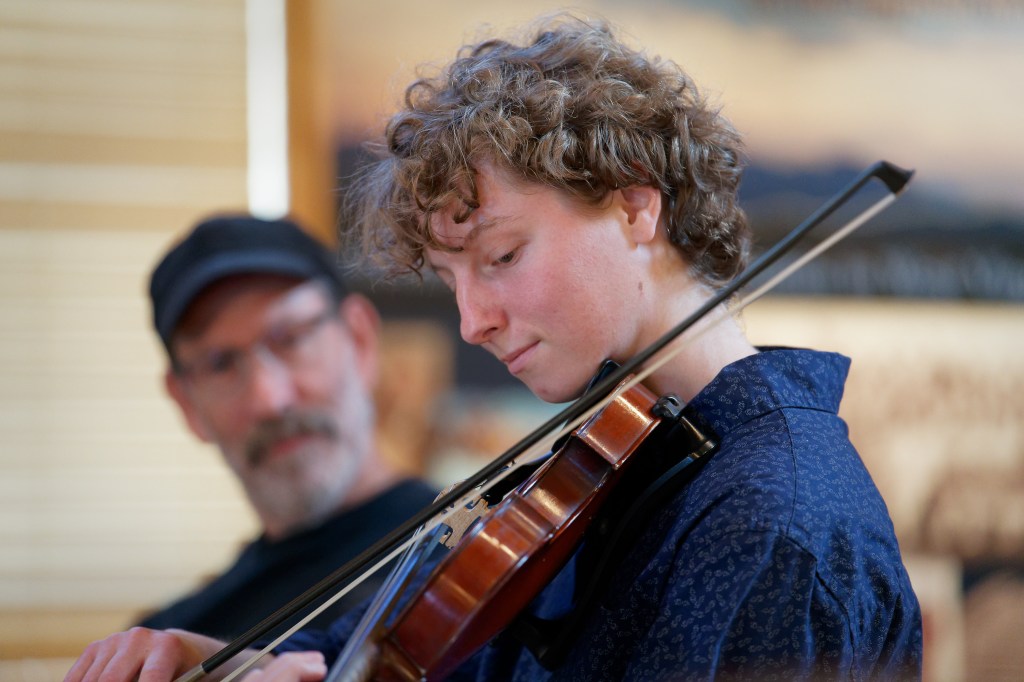
Chris Haddox (Monongalia County) and Mary Linscheid (Monongalia County) are both fiddlers—Chris, neck-deep in traditional Appalachian old-time tunes and lore, and Mary, a sponge for all things West Virginia. The two have spent several years playing music together both casually and professionally since they met in 2018. For the 2022-2023 West Virginia Folklife Apprenticeship Program, however, they decided to approach the fiddle from a different angle: fiddle repair.

Originally from Logan County, Chris Haddox began his musical journey at a young age, taking lessons in piano and saxophone before discovering the guitar in high school. Mostly self-taught, he played folk and pop music and learned to accompany his father who liked to sing Broadway songs. It wasn’t until he was in college that he dove into more traditional styles of music and fiddling. His first experience with instrument repair work occurred in the mid-1980s when he acquired a vintage Martin D-18 guitar that was sorely in need of repair. Not knowing who to take it to, Chris decided to do some research, buy some tools, and try his hand at repairing it himself.
“I’m kind of a tinkerer, so I wanted to learn how to work on my own instruments. And I did that just on my own, just reading books and taking stuff apart and probably shouldn’t have taken some things apart until I knew a little better, but that’s kind of how you learn.” — Chris Haddox

Through the former Augusta Heritage Center’s apprenticeship program Chris learned with Gilbert Stiles, a Preston County instrument builder and repairer. Although Stiles passed away before the apprenticeship was over, Chris took what he had learned from his mentor and finished the guitar they had started building together as well as the unfinished guitars Stiles left behind. Chris continued his instrument repair studies with Randolph County instrument repairman Bob Smakula, focusing mainly on fretted instruments. Since then, Chris has expanded his repair skills to all sorts of stringed instruments. Fiddle repair in particular, however, has become a unique interest for Chris.
“Working on fiddles, to me, is a much more intimate experience than working on guitars, banjos, mandolins, for example. There is something about the shape, the size, the lines, and the entirety of the fiddle that just makes it seem more human than some of its stringed counterparts.” — Chris Haddox
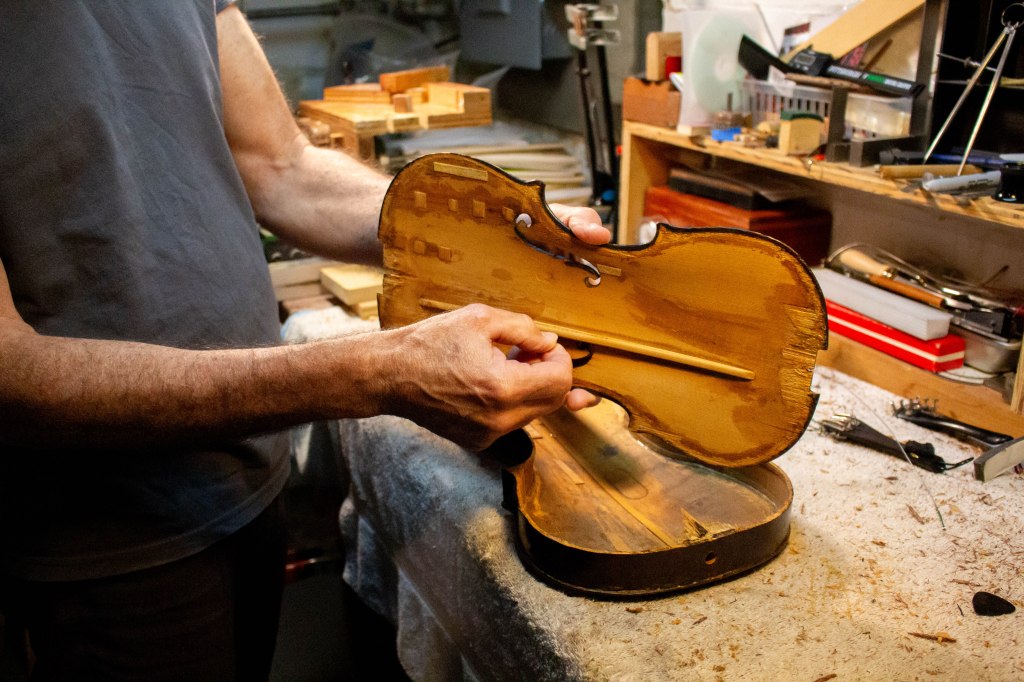
Mary Linscheid was born to two classical musicians, and from the time she was five-years-old until she graduated high school, she studied classical violin. As a teenager, she began attending the Morgantown old-time and bluegrass jams where she fell in love with not only fiddle styles but also the culture surrounding traditional music. Although she had very little background in instrument repair work at the time she began her apprenticeship with Chris, she was no stranger to hands-on work having grown up on a farm where she learned practical carpentry from her grandfather. Through this apprenticeship, she learned not only how the fiddle works on a physical level, but also how repair work deepens her relationship to her own fiddling and the larger story of local music-making. In particular, she saw a need for another fiddle repairer within the Monongalia County old-time music community—which has been steadily gaining younger musicians—and wanted to fill it.
“It’s a way to help sustain the music-making in my community—by being able to fix these instruments and make them sound the way the player wants them to sound.” — Mary Linscheid

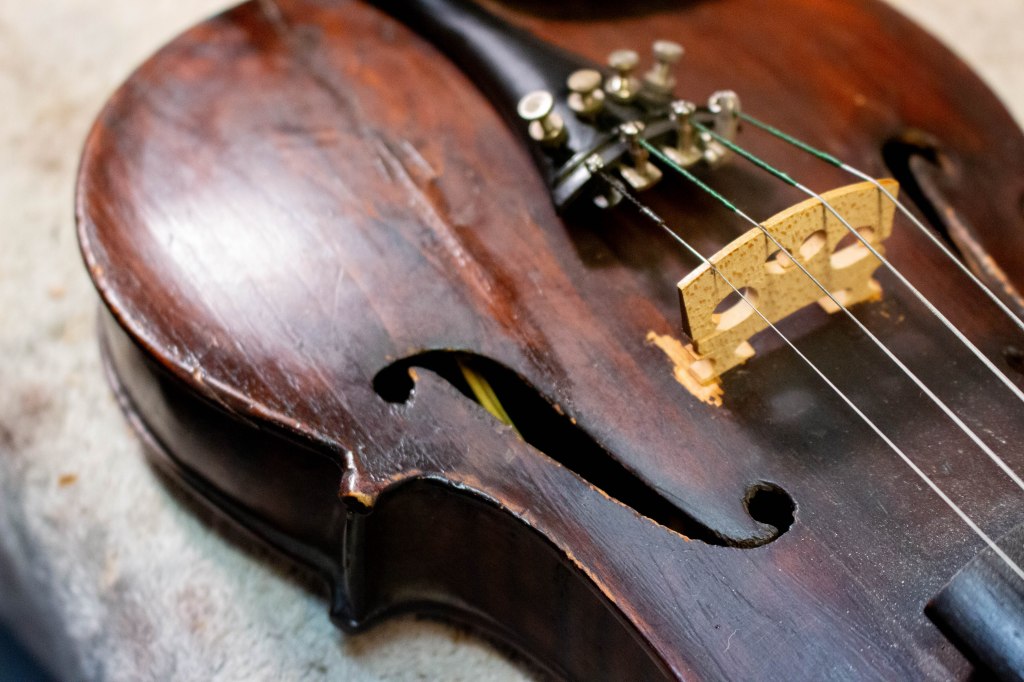
From their very first session, Chris had Mary take measurements on several fiddles in order to get a sense of what the standard dimensions were and how each fiddle differed from those dimensions. Chris taught her that—as a repairer—it was more important to figure out where things need to go in relation to the “landmarks” on a fiddle (i.e. f-holes, fingerboard, etc.) than to align them with the standard dimensions.
“[Fiddle repair] is kind of like fixing a car that maybe was never built right in the first place.” — Chris Haddox

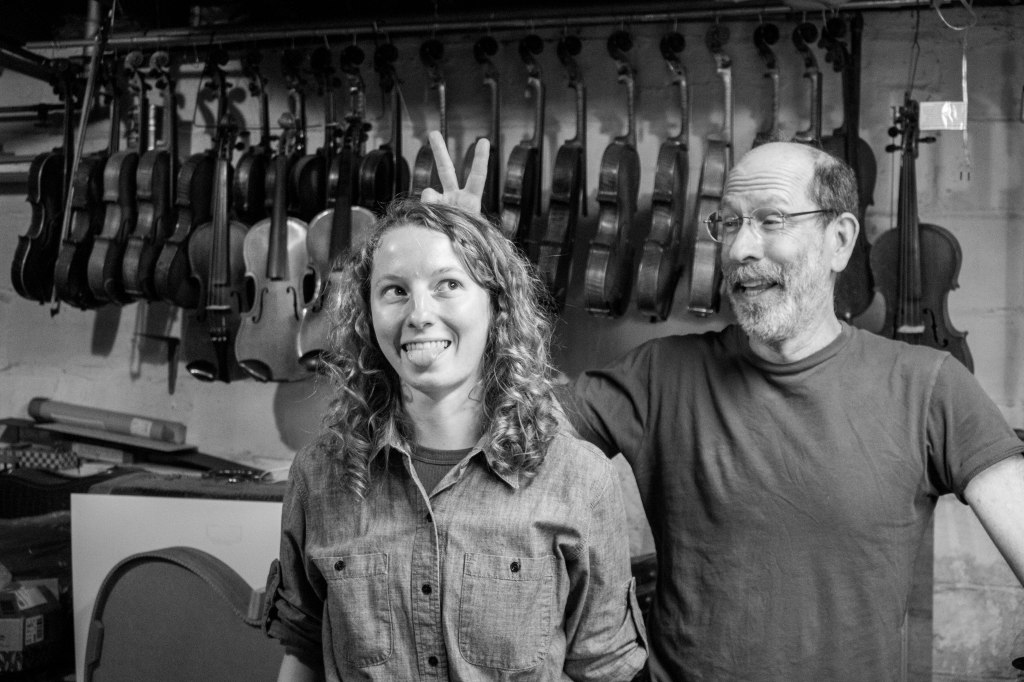
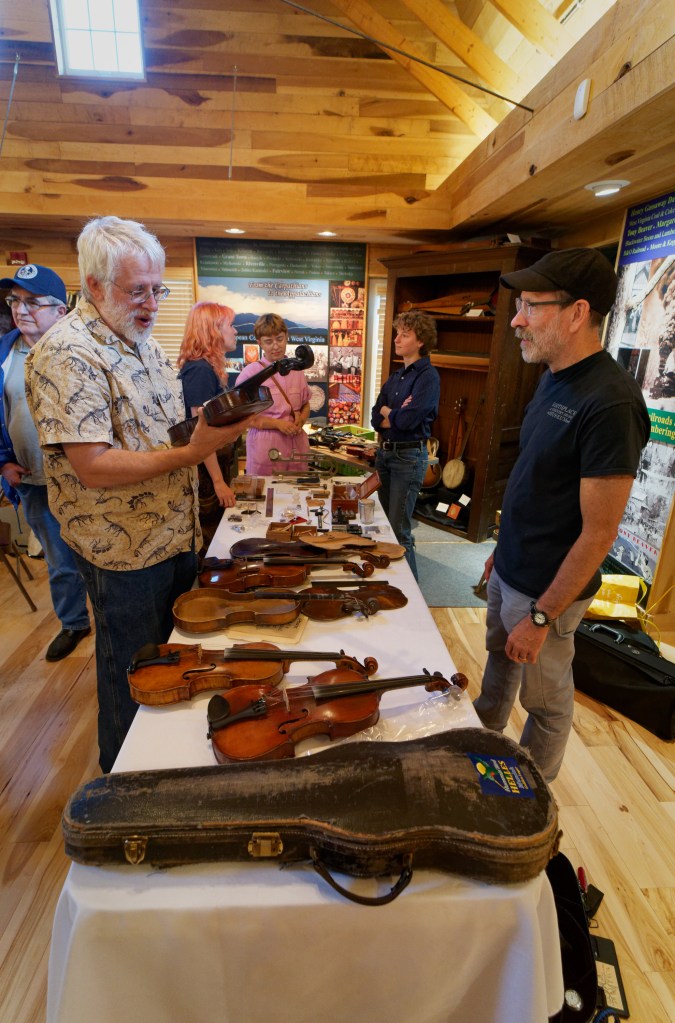
Once a week, the pair would meet in Chris’s basement workshop where fiddles—all in various states of repair—were stowed in every corner. At the workbench, Chris and Mary sanded, glued, sharpened tools and dulled them again. Mary tried her hand at things like fitting a bridge or positioning a soundpost. And while many repairers have set ways of doing repair work, Chris made it a point to show her several different methods of getting the same results, drawing on what he had learned from other repairers and from his own experience. Unlike the 1980s and 90s when Chris first learned instrument repair, however, the internet has become a huge resource for repairers.
“It’s kind of fun to just get on YouTube and go, ‘oh, wow, I never thought about doing it like that,’ you know. That’s the way [the internet] is kind of changing tradition or becoming part of the tradition.” — Chris Haddox

For Mary, this year-long apprenticeship was just a way to get her toes wet. Fiddle repair is a slow process and it would take time to develop not only the technical skills necessary for the work but also the instincts. Through repair work, she now finds herself existing in both the behind-the-scenes of traditional music-making and in the forefront as a fiddler. Today, Mary has a fiddle she repaired through the apprenticeship, bringing from unplayable to being her primary instrument. She occasionally does minor repair work on her friends’ fiddles as well as she continues to develop her skills. While the repair tradition is often less noticed than the music-making tradition, Mary and Chris don’t see it as something that is in danger of fading away. Rather, these traditions are two sides of the same coin:
“I think as long as people are playing music, playing fiddles, then there will be fiddle repairers and people needing instruments repaired…” — Mary Linscheid


More Projects from Chris Haddox
Check out Chris’s original music here.
Learn about Chris’s ongoing research on Folk Music of the Southern West Virginia Coalfields here.
More Projects from Mary Linscheid
Listen to Mary’s solo EP “A Place To Grow Old”
See her band The Shoats perform.
Mary’s senior thesis research: Precious Memories: Reuniting the Carvell Collection with Monongalia County Churches





About the Author
Mary Linscheid holds a B.A. in English (Creative Writing) and minors in Appalachian Music and Appalachian Studies from West Virginia University. She has written articles for Goldenseal Magazine and Journal of Appalachian Studies, and has had poetry published in WVU’s Calliope and the Anthology of Appalachian Writers (vol. XVI). Her band—The Shoats—won the Neo-Traditional Band Contest at the Appalachian String Band Festival in 2023 and continues to perform widely and release music.
Featured interview quotes, recordings, photography, and videos are produced by the West Virginia Folklife Program.


The West Virginia Folklife Apprenticeship Program is supported by the National Endowment for the Arts and the West Virginia Humanities Council.
Read the 2022-2023 West Virginia Folklife Apprenticeship Program featured blog posts linked below:
- Fiddle Repair with Chris Haddox & Mary Linscheid, written by Mary Linscheid
- Old-Time Fiddle with Gerry Milnes & Annick Odom, written by Mary Linscheid
- Clawhammer Banjo with Joe Herrmann & Dakota Karper, written by Mary Linscheid
- Appalachian Storytelling with Bil Lepp & James Froemel, written by Adam Booth
- Mushroom Foraging with Sharon Briggs & Anthony Murray, written by Emma Goldenthal
- Soul Food Cooking with Xavier Oglesby & Brooklynn Oglesby, written by Emma Goldenthal
- Fiber Arts with Enrica McMillon & Barbara Weaner (Featured in Fall 2023 Goldenseal), written by Jennie Williams
 wvfolklife.org