
Vintage Instrument Repair and “Rediscovering Old Friends” in Retirement
Written by West Virginia State Folklorist Jennie Williams and edited by Laiken Blankenship. A version of this article is published in the Summer 2024 issue of Goldenseal magazine.
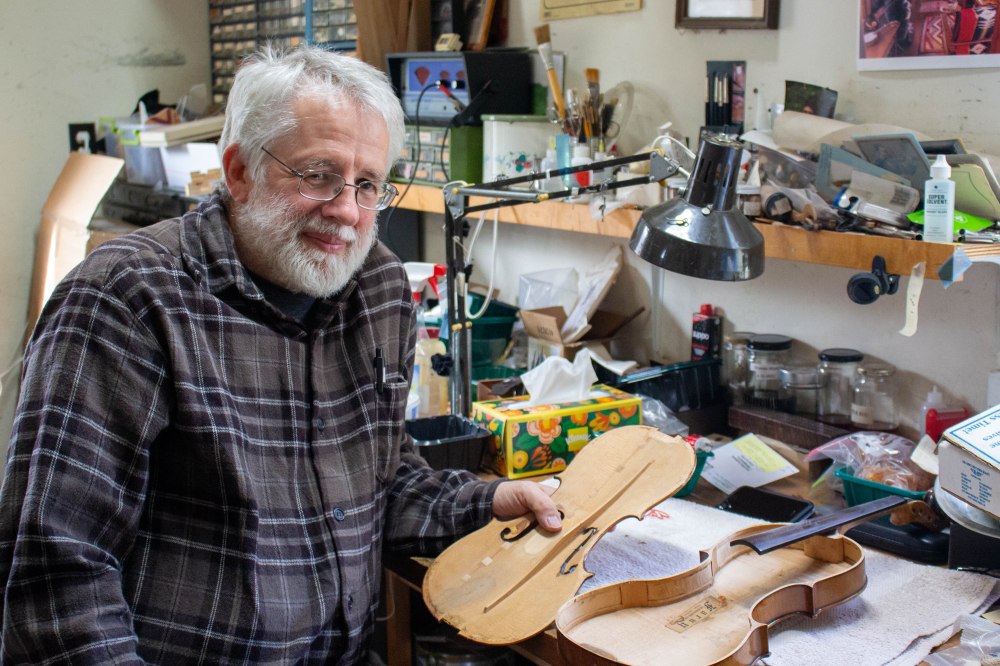
Bob Smakula, owner and proprietor of Smakula Fretted Instruments in Randolph County looks forward to devoting time to his own long-awaiting projects in retirement. Over the last 50 years, Bob built his instrument repair career based on his passion for vintage stringed instruments, teaching, and playing music.
Brought up in Cleveland, Ohio, Bob learned how to build mountain dulcimers from kits for his parents’ friends at the age of 14. His dad Peter H. Smakula was an expert mechanic and they played old time music, bluegrass, and folk music together for a time in the Smakula Family String Band. In 1977, Bob and his dad opened the Goose Acres Folk Music Center. As he learned to build and repair, Bob would seek out any source or trade catalogue on musical instruments he could find. He remains close with former Goose Acres employee Kevin Enoch, who is now a well-regarded banjo builder in Maryland. “We communicate every week at least,” Bob says. In specialized instrument repair communities, practitioners often share their knowledge with each other, especially among niche topics like 19th century banjos.
In 1978, Bob attended the Augusta Heritage Center workshops in Elkins, West Virginia to learn instrument making from Paul Reisler for five weeks. The Augusta Heritage Center would play a critical role in Bob’s life and career. He met his wife Mary there at a dance in 1983, taught classes in repair for over 25 years, and connected with many musicians and aspiring repairers. Bob reflects, “There were always certain students that you could tell really got it. And many, a good proportion have gone on to be professional instrument repair people.” He laughs, “and some that didn’t, they just became good hobbyists—you knew they weren’t going to screw anything up.”

In 1989, Bob married Mary, moved to Elkins, and opened Smakula Fretted Instruments. By word of mouth, his local client base grew while he also received instruments shipped from across the world. By the late ‘70s, he learned to be attentive to governmental policies that affected the international importation of products made from endangered species. Vintage instruments can be made from these natural resources, such as Brazilian rosewood, which is a popular tone wood, and mother of pearl shell used as decoration for early banjos. Nevertheless, Smakula Fretted Instruments still invites an array of stringed instruments to enter the workshop in various states of playability. “Unique things that you just don’t see every day,” as Nate Druckenmiller describes. Famous instruments have come across Bob’s workbench including a 1944 Martin D-28 herringbone guitar that once belonged to banjo star Don Reno. Bob’s employees, Andy FitzGibbon and Nate Druckenmiller enjoy researching these instruments as they repair them and hone their specialized skillsets.
Andy FitzGibbon began working at Smakula Fretted Instruments when he was only 18 years old. He attended an Augusta workshop to learn from Bob, knowing that playing music and tinkering with instruments truly interested him. While attending the workshop, Andy learned that the music store where he had worked in New York state had collapsed suddenly. Bob, recognizing Andy’s potential, offered him a job. Twenty-five years later Andy is now an expert in historic banjo restoration and has since fully restored Bob’s 1903 Fairbanks banjo—a Smakula family heirloom.
Nate Druckenmiller, who specializes in acoustic guitar repair, grew up playing old time music and bluegrass, like Bob and Andy. Nate met Bob when he was learning to play fiddle and first started attending the Augusta workshops. Originally from eastern Pennsylvania, Nate attended Kutztown University and received a BFA in Crafts with a concentration in Furniture Design so he could follow his creative drive. He discovered that he was more interested in working on instruments rather than furniture building, so when the opportunity presented itself, he followed his partner to Elkins about 10 years ago and has been working with Bob ever since.

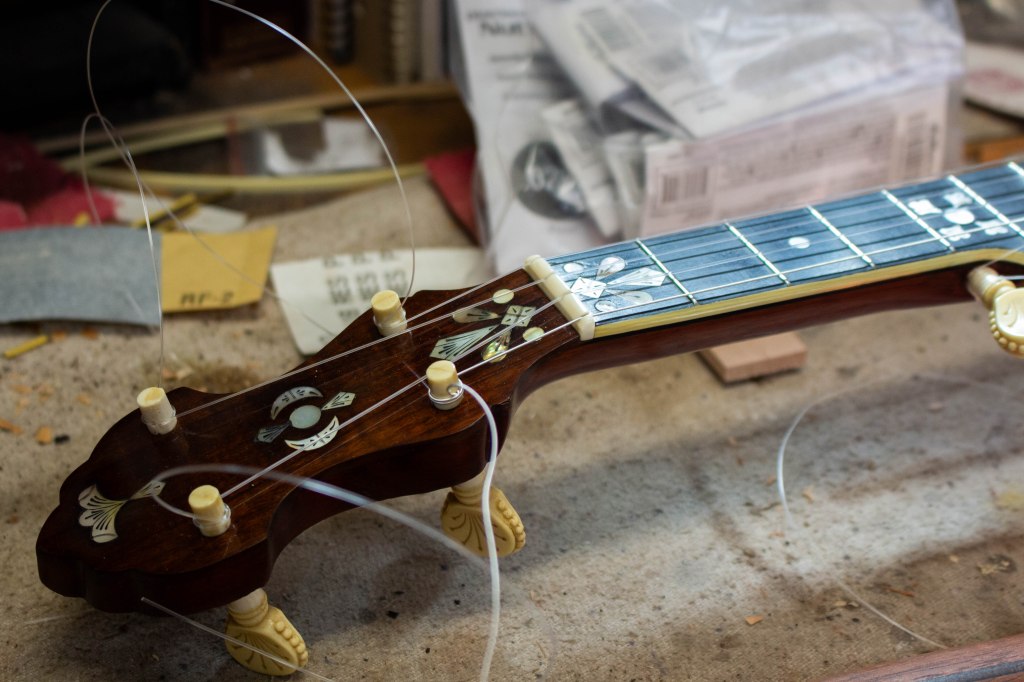


When they approach a repair project, they tap into their knowledge of the history of the manufacturer and consider common techniques that the maker would have used at a given time. “The materials are things we’re familiar with,” Bob explains. “It’s going to be hardwood back and sides on a guitar and a spruce top, put together with hide glue. Most of the time, we know exactly what’s gonna go on.” However, the instruments often present new and intriguing challenges, such as finding matching wood or fixing an unusual neck joint. Sometimes they need to invent a jig that only helps to complete one job. “You have to be clever—none of what we do is textbook,” Bob advises. “There’s always going to be a surprise.” Problem solving sets instrument repair apart from building. An instrument builder works with new materials and designs a product they can manufacture and recreate. Whereas, like a historian, a repair expert researches and observes the instrument in front of them and determines the most appropriate fix for it. “When you build something, deservedly so, I think it’s important to put your name on it and put your spin on it,” Andy says. “My goal with repair work is that people won’t know that I’ve done it by looking.”
Bob will continue to sell his inventory of instruments, antique parts, and banjo heads, but will soon pass the restoration and repair torch to his longtime apprentices—Andy FitzGibbon with Laurel Mountain Machine Works banjo restoration and repair and Nate Druckenmiller with Leadsville Guitars. Andy and Nate see that Bob has had to set aside passion projects over the years in the interest of managing his business. Returning to them will be like “rediscovering something that you were excited about,” Nate reflects. “It reminds me about why you got excited about it in the first place.” Bob agrees, when he pulls out old projects, it will be like “rediscovering old friends.”

 wvfolklife.org